Friday, April 25, 2008

Egypt

The plane from New Delhi took about eight hours and we had a brief stopover in Doha, Qatar. And when we say brief we mean it; as we exited the airplane our connecting flight was announcing last call! We arrived at the Cairo International airport sans a Lonely Planet guide book. Given our recent experiences, we mistakenly thought it would be an interesting experiment to just wing it. We also had not had time to make any reservation so we pretty much had no idea where to go from the airport, consider it LP's revenge after Jason's disparaging remarks in previous posts. Our bewildered looks must have made us an easy target because several hotel touts hounded us and we finally gave in to one who showed us a brochure and quoted us what seemed a reasonable rate. Of course, he then took us to a different hotel that was a dump and we told him to take us to the one on the brochure. When we arrived, the hotel informed us the tout had lied about the price and also had lied about including the transfer from the airport. After arguing with him for much too long, we finally paid him half of what he wanted and told the hotel ‘manager’ to pony up the rest since he was trying to convince us we should just pay him. We planned to check out of the hotel the next day, but our plans were sidetracked by a three-hour tour sales speech from the ‘manager’ from the previous night. We don’t know why we let him waste our time and by the time we checked the other hotel, it was booked up, so we begrudgingly returned to the New Palace Hotel. Although he stuck around for a couple days, the ‘manager’ eventually disappeared from the hotel once he realized we were not going to book a tour through him. In all likelihood, he was a tour agent tout in cahoots with the taxi driver to completely scam us by overcharging us for a tour. When we came to this conclusion, we decided we’d ‘forget’ to return the old guide book they had loaned us.

Despite these initial hassles, we were excited to start a new adventure. Cairo is a city that is one of the most visited in the world because of its ancient history, but it is also a bustling modern metropolis of close to 40 million people. The downtown area, where we were stayed, is lined with cafes where the male locals hang out smoking sheesha (flavored tobacco) out of houkas and drinking unfiltered black tea with lots of sugar (we would later marvel when one Egyptian added five heeping spoonfuls into his cup). The prevalence of smoking amongst males is a staggering 95% and for those like us who loathe 2nd hand tobacco smoke, we just had to grin and bear it. And, although we’ve been exposed to some awful traffic on our travels, Cairo’s was the worst yet because for the first time, as pedestrians, we worried about staying alive as we crossed the street at crosswalks since drivers ignored red lights, pedestrians, and sometimes even sped up as pedestrians crossed. We were thankful but surprised that we didn’t see anyone hit by cars. On the flip side, Cairo is a very safe city and we never felt worried about our safety other than when we had to cross the street. We also enjoyed the music emanating from the cafes and we grew to love Arab music during our six weeks in the Middle East. Finally, we marveled at how ‘clean’ Cairo was, which is a good example of how subjective our perceptions can be; having just arrived from India, the filthiest country in the world, Egypt seemed clean to us, when nearly everyone else remarked how dirty it was. We quickly dove into the local cuisine, and feasted on fresh shwarmas and yummy eggplant. Although the food was pretty good, we couldn’t help but compare it to one of our favorite restaurants in Chicago, Pita Inn. However, the sweets were absolutely delicious, even tastier than in India, and we returned to one of the local pastry shops every night to sample the various culinary treats.

During our time in Egypt, we were inundated with visual and aural expressions of the Islamic faith. One day we explored an area called Old Cairo, where it seemed as if there was an ancient Mosque on every single block. Each morning at about 5 am, the amplified sound of the muezzin asking the faithful to attend prayers at the mosque. Earplugs were thus a necessity for sleep. Friday is their holy day and almost everything, except stores and public transportation, were closed. Plus, since Muslims pray five times a day, we heard the prayers often and since there are so many mosques, at times the city was so loud we wished we could have walked with earplugs. All of the local televisions stop broadcasting during prayer times as well. We visited the Citadel, an ancient fortress that contained an incredibly mosque, a war museum, and great views of the city. Since it was a clear day, we could see the Pyramids even though they were about 10 miles away. In the mosque, it was fascinating to see the faithful embarking in their prayers while hordes of tourists (like us) snapped photographs. The war museum was massive, which is not surprising given Egypt’s long and war-filled history. What was surprising is the way it seemed to glorify war. And, like many of the tourist activities, the movement within the museum was highly controlled by the government, and we had to go through the entire thing in order to get to the exit (i.e., we couldn’t turn around)!

And of course we visited the pyramids of Giza, the only of the seven ancient wonders that are still standing, on a guided day trip along with the ancient city of Memphis and the necropolis of Saqqara. The pyramids, three large and six small, were an amazing sight surrounded by tourists, locals, and camels for hire. Our guide helped us take some hilarious pics, and this one's for all those readers who remember the 80s. We entered the tunnel of one of the large pyramids which was dark, narrow, and stiflingly humid. Two people could barely pass one another and we had to stay hunched over the entire time, save for a brief reprieve in the middle. The people coming out were panting as we were going in and at one point it got so dark and claustrophobic that Priti started turning around but Jason supported her through this exposure therapy process (for professionals only–hah!). After the difficult descent, we reached the center where there was an empty tomb; a bit anti-climactic but still interesting to see. Saqqara is 5000 years old, was originally one huge cemetery, and the tombs are lined with sunrays. Many of the limestones of the tombs were taken to build homes and Mosques in Old Cairo about 4500-5000 years ago and it was sad to see the top of the Step Pyramid at Saqqara was missing its top due to the long-gone thieves. We learned from our guide that statues usually have the left foot forward which means to follow your heart and if they had hands across their chest, this indicated death.

Then we were off to the Egyptian museum, which is so massive that it would take months to see every artifact on display. In addition to its shear size, the place is always jam packed with large tour groups, which make it difficult to maneuver around. Instead, we spent one frenetic afternoon hitting the highlights, including the sarcophagi and death mask of King Tut, which were made out of pure gold. At the Egyptian museum we learned that people were buried with animals for a variety of reasons: as food so they would not starve in the afterlife, as sacrifices to various Gods, and of course as companions (Jason decided he’s taking his cats Billy and Simone with him into the afterlife). Jason bought an extra ticket to see the mummy room, which contains nine bodies and is not for the faint of heart. It was amazing how well-preserved the bodies were and a few of them even still had their hair. The only annoying aspect was that he wasn’t allowed to bring in his camera, even though just about every other person was taking pictures with their cell phones. Afterwards, we walked along the Nile River and enjoyed the view of the many boats.

That evening, a local Egyptian named Khaled helped us change our flight to Kenya (we are no longer going there due to the recent violence). Afterwards, he invited us to tea, smoke sheesa and watch the African Cup match between Egypt and Kenya. Priti was the only woman in the entire café and Egypt won! This was followed by the best food in Cairo called Koshary which is a mix of lentils, pasta, fried onions, and spices. Delicious!!! We found the Egypt had some of the nicest people we’ve met on our trip but at the same time there are a lot of jerks who are always trying to scam tourists. We could list a dozen examples but we’ll just leave it at that.

The next day, we traversed five hours west by bus to Bahariyya Oasis, a haven of green in the middle of the desert. This area was filled with palm trees and Bedouin culture. The desert in Egypt is barren outside of the oases. Nothing grows – no trees, no shrubs, not even weeds. The contrast between an oasis which has palm trees and water to the Egyptian desert is extreme. Tucson, Arizona seems like the Northwest US in comparison to the desert in Egypt! On a 4WD tour, we saw the Salt Lake which has the run-off of agriculture water but there is so much salt in the ground that the water foams at the edge. In the vicinity, Pyramid Mountain is a natural mountain that looks just like one of the pyramids near Cairo. It is famous for dinosaur fossils found there in the early 20th century. Nearby, we found full skeletal remains of a cow. The desert is deadly! Then we went to a camel farm where one of the camels stuck her head over the stone wall and wanted to be petted the entire time. Camels are so cool! The tour guide told us that often, the camel man will feed his camel marijuana so they remain dazed and chill. Maybe that’s why Jason’s camel kept chewing and eating in Jaiselmer, India. Hmmm, makes sense now. We proceeded to Crystal Mountain which was entirely made of quartz crystal rocks. Due to being protected land, we couldn’t pick up any of the crystals although Priti imagined making thousands and thousands of pieces of jewelry from the crystal stones. (Alas, no crystal necklaces as gifts for those at home). It was not that spectacular in the sense of how it looked from afar until you got close to each sparking piece and observed the way the light was reflected on the mountain.

The highlight of the tour, indeed one of the highlights of the entire trip thus far, was the White Desert which is called Sahra al-Beida. This place felt like another planet. Blinding white rock formations were everywhere and came in myriad shapes, some of which were familiar, such as animal profiles and massive mushrooms. They were shaped by wind erosion and were surreal. At sunset the sky was alit and pink and the silhouettes of the white rock formations became even more spectacular. The sand around the white formations, littered with sparkling quartz, gives the landscape the feeling of snow with the sunlight beaming on it eerily at times.

After camping in the desert under the star filled sky, we awoke early the next morning and adventured to the Black Desert. It was wild to see the desert transformed from white to black. The Black desert was formed over a millennia as wind eroded the mountains and spread a fine black powder over the ground. It ended with a small, black volcano shaped mountain, part of a fault that runs through Bahariyya Oasis. We also went to Gebel az-Zuqaq which is a mountain known for red, yellow, and orange streaks in the limestone rock base. It was pretty cool and we took plenty of pictures of all the things that we saw on this excursion. Although we camped in the desert, for those itching to go to Egypt, it can all be seen in a day.

We met some cool people on the 4WD adventure. Christine, a Canadian who currently has been living in Taiwan for three years as an English teacher, shared a story about ghost wives. When a family member loses a young daughter who has not been married, they leave money on the street or something of value like a watch or jewelry. The man who picks it up is then obligated to marry the ghost wife and she even becomes the first wife if he is already married! He has no choice in the matter or else he will be haunted by the female ghost. His family and the ghost wife’s family have an actual wedding ceremony and party. Shangwei, Christine’s Taiwanese boyfriend, refuses to pick anything up from the street. Anyways, Taiwanese people think that the ghost wife and the man who picks up the item of value are somehow linked spiritually and that is why the man is obligated to marry the ghost bride. Linda, a fellow American who has worked in radio with Tavis Smiley and Air America, was recently in India and shared that she became spiritual while in India. She is one of many people who have told us that they found spirituality while in India. She described being in a silent ashram in Northern India and could not speak to anyone, not even her roommate, for 10 days and how during the day, the silent meditation was in a room full of other people. She described being at peace with herself since her ten days of silence. It was hard to imagine being silent for that duration of time. Unfortunately, they left after the first day and our camping companions were a French couple who were just about the least friendly people we’ve met.

After our couple of days in the desert, we started our tour of temples in Egypt. The first stop was the city of Aswan after a miserably long overnight train ride sans reclining seats, even though they were considered first class. (How we missed the trains of India with berths.) Aswan is Egypt’s southernmost city and unlike Cairo, which was having its coldest desert winter in decades, Aswan was warm, toasty, and picturesque with feluccas (traditional Egyptian sailboats) scattered on the Nile River. In ancient times, the city was the crossroads of caravans and a gateway to Africa. Immediately after arriving at our hotel, we were ushered to start the tour of Aswan. Despite how hurried our tour guide seemed, we waited 40 minutes for the van driver. We soon learned that if it was about the tour guide’s or driver’s time, then we should hurry but otherwise, most of the tour guides didn’t care if tourists had to wait. Hence, the tour started an hour later although the tour people kept saying “two minutes” while everyone in the van grumbled. Although we were supposed to visit the High Dam, we were told, due to shortage of time (!), that we would have to see the High Dam tomorrow and today only had time for Temple of Isis at Philae. From the tour guide: Philae means friends or couples. The original island on which the temple of Isis stands became flooded after the Egyptian government opened the High Dam. So then, they moved the entire temple and reconstructed it from 1972-1980! Originally it was built during Alexander the Great era (around 326 BC).

During our many visits to various temples, we learned a lot about the different gods of ancient Egypt and the mythology. One of the more entertaining stories involved an incestuous love between the brother and sister gods Osiris and Isis (goddess of beauty, love and magic). After they fell in love, their older brother became jealous and had a gold coffin made to fit Osiris. This older brother threw a party during which he offered the gold coffin to whoever fit in it. Of course, Osiris fit perfectly, was shut inside of it, and then his body was dismembered into fourteen pieces and discarded throughout Egypt. Isis, grieving over her lover/brother, used her magic to transform her body into a vulture and searched all over Egypt for him. And during that search she gave birth to their son Horus who is symbolized by a hawk due to her form as a vulture. She found 13 of the 14 pieces of Orisis’s body and wept over the very important missing body part, thus causing the flooding of the Nile River. The lost body part of the God Osiris was then symbolized by a giant obelisk, a phallic symbol which is found throughout Egypt.

After visiting the Temple of Isis, we walked through Aswan along the Nile River which flowed from South to North around beautiful boulders and small islands in the river. Because of the flow of the Nile, southern Egypt is referred to as ‘upper’ while northern Egypt is called ‘lower.’ We visited the old Fatimid Cemetery which had a collection of low, mud-brink buildings with domed roofs and mausoleums dating from the 9th century. This was followed by a wonderful riverside dinner and then a short visit to the Nubia Museum where we learned about Nubian culture.

We had to wake up at 4 am the next day so we went to bed fairly early. So far on this world-wind adventure, we often have opted to do things on our own if we can. In Egypt, however, to travel to specific sites you have to be part of a convoy, an armed police escort, whether you are part of a tour group or hire a private taxi to the site of interest. This was the government’s response to a bombing of a tourist bus near Aswan which resulted in many deaths and the decline of the tourist economy. So the 3:45 am wake-up call from the hotel was not by choice but due to the 4:30 am departure time of the convoy to travel a few hours to the site of Abu Simbel where the majestic temples of Ramses II and Hathor were located. It was dark in the morning and all the tour buses, minibuses, and private taxis lined up alongside the main road with a police escort sandwiching both ends. Unfortunately, we weren’t able to sleep in the minivan since the driver disregarded lane lines around curves and despite all the vehicles having the same destination, the driver would quickly and sharply pass tour buses and minivans. The only thing redeeming about the transportation was the spectacular desert sunrise, the second of half a dozen sunrises in Egypt we would see.

First, we went to the Temple of Ramses II, carved out of a mountain on the bank of the Nile River between 1274 and 1244, and rediscovered in the early 1800s when a Swiss explorer noticed a statues’ head sticking out of the sand in the Egyptian desert. Ramses II must have been a narcissist since as a Pharaoh, he deified himself and built this gigantic temple for himself and the ancient Egyptian gods Raharakhty, Amum, and Ptah. Ramses II had many, many wives and numerous children which often provoked the joke amongst Egyptian men when they tried to sell male tourists essential oils, that he would become like Ramses II. On the outside of the temple, there are four huge statues of Ramses II, three of which are completely intact. Inside the temple, there are more statues of the deified Pharaoh and Jason surreptitiously took a picture and was scolded by the ‘picture police’ who ignored the locals taking pictures with their mobile phones. The reliefs on the walls of the temple depict the pharaoh Ramses II in various battles, trampling over his enemies, and always victorious. At the back of the temple, the four gods sit on thrones and supposedly, every Feb 22 and Oct 22, the sunrise rays penetrate through the temple and illuminate the god of RaHarakhty, Amun, Ptah, and Ramses II. We were there about a week too early to see this phenomenon but we were told the place is an absolute zoo on those dates. Next we saw the Temple of Hathur which is next to the Temple of Ramses II. There was another ‘photo cop’ who seemed to target only foreign tourists but not the locals. This temple was magnificent and had statues of Ramses II’s Queen Nefertari and the gods Hathor (merciless god depicted as a cow) and Mut (god of Sky).

After seeing both of these temples, we waited for the entire convoy and headed back toward Aswan. At around noon, we went to the dock and boarded our felucca for a two night sailing adventure. We learned that the four Chinese people already on the boat had waited for three hours to start sailing, complained to their tour agency and received a partial refund. We tried to not let this alter our excitement about sailing yet we were assertive in terms of seeing the sights that were promised to us by the travel agent. First, we went to Kitchener Island on the Nile River. This island was a beautiful botanical garden with blooming bougainvilleas, roses, and other colorful flowers. It was peaceful walking around the island and watching the feluccas sail along the river. Later, we sailed around Elephantine Island which has a group of grey granite boulders that look like elephants bathing in the Nile River. On this island, we visited the ruins of Nebu from around 3000 BC which had temples, cemeteries, and a Nilometer which was used to measure the height of the Nile and to indicate if the harvest would be bountiful. The Nilometer affected the taxation system; the higher the river, the better the harvest and the higher the taxes on the merchants in ancient times.

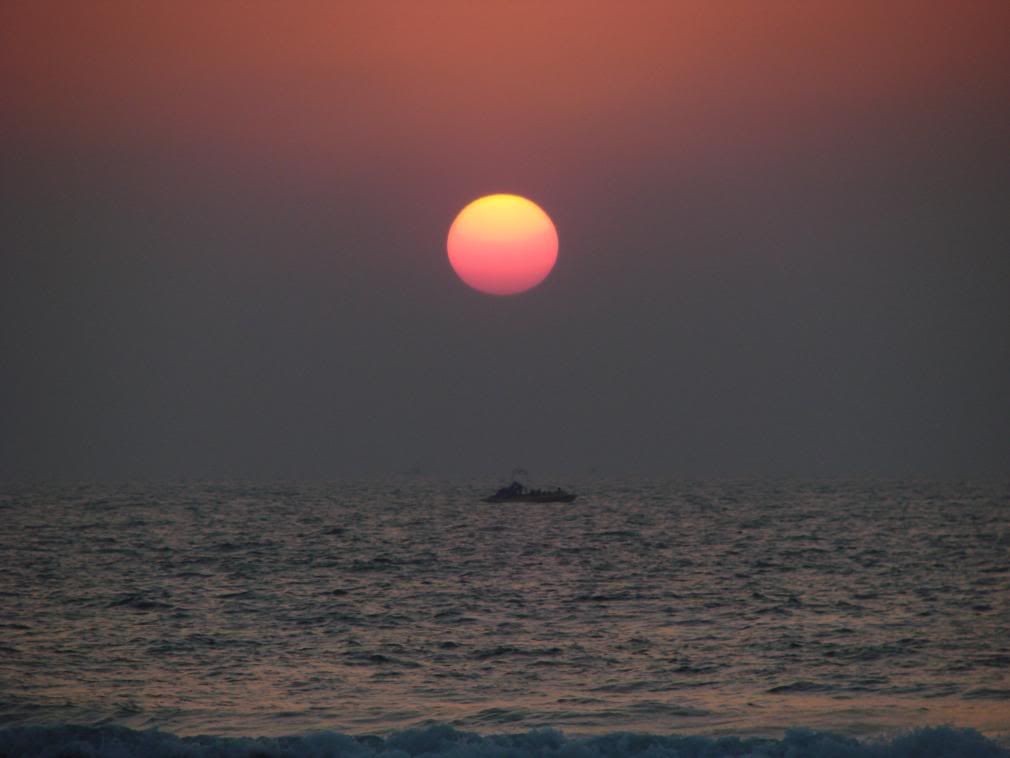
After visiting those sites, we had some smooth sailing down the Nile and beheld this amazing sunset. We engaged with the sailors and fellow tourists, enjoying the breeze and the blue water of the Nile River. We slept overnight on the felucca and were relieved to not be woken up to the sound of the amplified voice of the muezzin calling the faithful to prayer. On our second day, we spent more time along the dock than sailing and in retrospect we would recommend doing only one night on the felucca and not the two nights like we did. On the felucca, Priti witnessed two more sunrises, making the total of sunrises seen in Egypt more than those seen in the last seven months of travels. Although Jason was annoyed about the lack of sailing on the second day, Priti enjoyed the sun and almost finished reading a four hundred page novel, Family Matters by Rohinton Mistry (highly recommended reading).

During the day, one of the sailors anchored near his Nubian village and at his home, we had a milk coconut tea which was delicious. We walked around the village which has yellowish mud colored homes and the exterior walls are painted with domestic designs and of Egyptian men riding on donkeys, flowers, and other cultural images. At night, we were disappointed to anchor next to a cement set of stairs instead of an isolated sandy bank area of the river. This however enabled Jason to hang out with the felucca workers on shore and watch the Egypt win the African cup for the second time in a row and seventh time overall. Priti opted to stay on the boat despite being a football fan and knew Egypt had won once the honking of horns were heard from the vehicles of the nearby town. For the remainder of our time in Egypt, Jason would shout out the names of the two star players (Abutrika & Zidane) when he wanted to make a connection with the locals.

The following morning, after a fitful, cold night of sleep on the felucca, we woke up again at the crack of dawn and took a jeep to the ancient site of the Temple of Kom Ombo, which is along the Nile River but different from other temples because everything is doubled and perfectly symmetrical. In ancient times, this area of the Nile used to have crocodiles basking on the river banks and the temple has mummified crocs. After walking around and imagining ancient Egpyt, we headed to the parking lot where we were required by the Egyptian government to travel again by convoy to Edfu to see the Temple of Horus which is supposedly the most well-preserved one in Egypt. This temple was started in 327 BC and wasn’t completed until 57 BC by Cleopatra’s father. (And we thought construction in the USA was slow!)

After checking out the site, we were again herded by convoy to Luxor. This time, due to the position of our vehicle, we could actually see the police escorts. We weren’t sure if traveling in a convoy actually makes tourists more or less of a target but since Eygpt started requiring convoys, there have been no attacks against tourists. By the time we reached Luxor, it was mid-afternoon and we were starving, ate an awful babbaganoush at the hotel, and headed to see the ancient Temple of Karnak through a pre-arranged tour. This place was huge and everything was on a gigantic scale. It was built and added to for 1500 years and one of the most important places of worship during ancient Egypt. Almost every Pharoah left their mark here. The temple contained an enormous hall, “The Great Hypostyle Hall,” with a forest of 134 unbelievably huge papyrus shaped stone columns. These stone columns are bigger than any we have ever seen. Although we didn’t try it, it would take half a dozen people to circle their hands around one column. There is a paved avenue of ram-headed sphinxes that at one time connected all the way to Luxor temple which is 3 km away. This temple also contains the tallest obelisk in Eygpt at almost 30 meters. Plus, there is a large stone statue of a scarab beetle and our tour guide explained that the scarab beetle is a sign of good luck and encouraged us to walk around it – once for good luck, three times for marriage and seven times for a first child. Inexplicably, we didn’t walk around it, so hopefully that doesn’t cause bad luck, the ruin of our marriage or a barren marriage.

The day was long and we were worn out. We fell asleep early and despite wearing earplugs, we were woken up at 5am to the blaring sound of the nearby mosque. The decibel level was absurdly loud and it sounded like someone was holding a megaphone in our ears. Another typical Eygptian morning and another Egyptian tour. This time we drove to the West Bank of the Nile River and passed by fields of sugarcane that were strikingly green in comparison to the desert, golden-brown barren mountains in the backdrop. Locals were riding Siwa-style transport which are donkey drawn wooden carts on wheels.

Our first destination was the Valley of the Kings which is a collection of more than sixty separate tombs of Kings built deep into the mountains. It is located in the desert valley where nothing grows and the former Kings hoped that no one would be able to find and steal the treasures buried in their tombs. Our ticket stupidly allowed us to choose only three of the tombs. Together we saw the Tomb of Tuthmosis III. We had to climb a steep staircase in a steep ravine and meandered through a series of passages at odd angles in order to reach the tomb. The walls were adorned with paintings, some of which resembled stick figures drawn by a five-year-old. Together we also visited Ramses III’s tomb. We then split up and Priti thought Ramses I wthe best whereas Jason thought the Ramses IV was the best, because the entire ceiling was beautifully painted, and reminded him of the Sistine Chapel. No pictures were allowed so we bought a set of photos from one of the vendors. Next was the site of Deir al-Bahri, which was an amazing series of terraces of the Temple of Hatshepsut (a powerful female pharaoh) rising out of the limestone cliffs of the mountains. We also visited some of the tombs of the non-royalty, which were not quite as impressive but were very well-preserved. In the evening, we went shopping which was rather annoying as the shop guys were relentless in their attempts to entice you into their stores. Priti bought some pendants as gifts and Jason bought a scrabe beetle ring that is supposed to bring good luck. Then we went to Luxor Temple at night which was all lit up and mesmerizing to behold.

We were pretty tired from all the traveling so we opted out of a 15 hour bus ride around the Sinai peninsula and took an overpriced boat across instead. On the boat, when it started raining, we realized Jason had left his rain gear in India…doh! No wonder his bags had been so much easier to pack up. Our first stop on Sinai was Hurghada, which is a glaring example of tourism run amok (and in Egypt that is saying a lot). Dozens of unfinished hotels littered the beaches and the coral reefs were in awful shape. We went on a few dives, which were the cheapest thus far ($35 for two plus lunch on the boat) but the dumb divemaster took us to a spot with a strong current going against us. We ended up getting stuck there for over a week because the ferry across the water got cancelled twice and doesn’t run everyday. At least we met some cool locals (who in reality were a quartet of conmen but spared us since we made it clear we weren’t going to buy anything) who showed us a good time at the local belly dancing club. We learned that Egypt is sort of the flip side of SE Asia, in that young male prostitutes hire themselves out to hordes of older European women. For some strange reason, the converter we normally used did not work in our hotel but another bulky (and heavy) converter that Jason had used while studying in Oxford, did work. This marked the last remaining unused item that we had brought with us on the trip, and Jason was mighty thankful that he hadn’t thrown it away.

Ten days later, we finally made it to Sharm El-Sheikh, which is uncannily similar to Vegas and became famous after a big terrorist attack there in 2002. Jason spent a night at the casino playing poker. Interestingly, not only was the game played with US $, but Egyptian pounds were not even usable at the casino. He was going good until a Russian mafia goon showed up with a huge diamond studded cross hanging around his neck and a wad of cash worth at least $10,000. It only took one expensive hand of being bullied by this thug for him to walk away from the table. Throughout our time in Sinai, almost all of the locals complained about the nouveau riche Russians because of their obnoxious drinking and disregard for the underwater environment. We wanted to go on another dive but when we showed up at the dive center in the morning, it was completely chaotic and they had no certifications to show they were qualified. Of course we had already paid part of it so rather than waste our entire day fighting with them to give it back, we went out on the boat to snorkel. The coral was superb but the water was freezing cold.

We left after a couple days to Dahab, another popular dive spot on the Red Sea but with a much cooler vibe. Jason did some of the best dives yet, including a deep dive down a narrow canyon called the Bells, due to the frequency with which inexperienced divers bang their tanks against the walls during the descent. He also took an excursion to the world-famous Thistlegorm wreck dive, a British casualty from WWII. The dives themselves were incredible, particularly the penetration dive, which involved swimming through the wreck past rows of jeeps, motorcycles, and guns. One room was so narrow that we could only swim through one at a time, and buoyancy control was essential as the clearance above and below was less than a meter. There was also one section where an air pocket had been created above the water, which was cool to see but Jason wisely left his regulator in rather than try to breathe the air. Unfortunately, everything other than the dives was a mess. They put us all on a boat but had nowhere to sleep so we all were sleep-deprived before the dive. Then, the waters were very turbulent and about 1/3 of the passengers got sick on the boat. Because it is one of the most popular dives sites in the world, there were many other boats as well. When we ascended after the first dive, we had to swim underneath another boat which was bobbing up and down with the waves, at times just barely missing the divers underneath. Getting out of the water onto the boat was a total nightmare and one poor woman actually vomited into her regulator (ewww). My dive buddy on the first dive, like many others, decided to forgo the 2nd dive, which was a shame because that was the penetration dive and by far the best. Thus, inexperienced divers should think twice about going to this dive site because it is pretty expensive and the groups are too big. Actually, it seemed like a recipe for disaster but thankfully everything went off without a hitch…this time.

With the extra few weeks we had by pushing back our Kenya flight, we decided to visit Israel and Jordan, so stay tuned.

Monday, April 7, 2008

India, part 3

We arrived in New Delhi from Jaiselmer after twenty hours on the train, which surprisingly was not that bad. The Second Class 3AC overnight train had six berths in a compartment and provided bedding and blankets. Despite being tired, we were excited to see Priti’s mother Premlata (she goes by Lata) after so many months. Lata had arrived in New Delhi the previous day and was staying with Chuni Auntie (in India, elders are referred to as ‘uncle’ or ‘auntie’), a cousin of Priti’s father and a great friend. After meeting the family German Shepard named Kush, which means ‘happy’ in Hindi, the reunion was warm and relaxing. As is common among the middle class, they had live-in servants, and we were treated to our favorite Indian dishes. In addition, in India, the family is an extended one. So the three-bedroom condo consisted of Chuni Auntie, her husband and their married son and daughter-in-law. Their other daughter, who had a beautiful baby girl a week after we left (congrats!) lived with her husband three stories down in the same building. During these few weeks we met so many wonderful people and although we don’t remember everyone’s names, we will always remember how they went to every length to ensure that we were enjoying our visit. Thank you!

We didn’t do any sightseeing in New Delhi and saved that for another trip to India. The following day began the journey with Priti’s Mom to Varanasi (or Benares, another Indian city with two names). This journey involved another overnight train on which we met a French woman who’d ridden Kingfisher (Jason’s camel on the Jaiselmer, Rajasthan safari) the day after our safari and we had a pleasant evening exchanging some of our travel stories.

We arrived in Benares and were greeted at the train station by friends who quickly became like family. Benares is the holiest city in India and Hindus pilgrimage there throughout the year and it is believed that all the Hindu Gods have set foot in Benares and bathed in the mighty Ganga (or Ganges) river, which is considered the source of life in Hinduism. We visited several temples which were jam-packed with worshippers. We then took a boat ride along the holy river and, as is customary, we sprinkled water from the river onto ourselves before eating. Many Hindus’ dying wish is to have their ashes sprinkled in the Ganga River. As we headed up the river, we passed along dozens of ghats, which are steps leading down to the river. It was fascinating yet disgusting to see the many uses people had of the river, including washing machine, toilet, and yes, even water fountain. Several of the ghats are used for cremation ceremonies and we witnessed the cremation of several bodies from the boat. Although the air was smoky, it did not smell of burning flesh. We were fortunate to go on the boat ride because the following day, all the captains went on strike due to new higher boatmen’s license fees being imposed by the city government. On the way home, we stopped for some mythai and got the best carmel barfi we’ve ever had.

Benares is a city of small streets that curve and angle every which way like a maze, and it is easy to get lost in the narrow alleys which is part of the fun. Down these alleyways, there are multitudes of street vendors selling just about anything and scooters weaving their way through the crowds of people and the revered cows. Cars are too wide to fit down the alleys. Priti and her mother had a harrowing experience with an angry bull that was bucking and running down a gulley. Priti ran into a strangers’ home and her mother ran into a nearby hotel for shelter. Although we both were frightened at the time, we laughed about it later. We’re pretty sure this cow was the same one that chased after our fellow globetrekkers Paul and Sapna just a few months earlier since it happened very close to the hotel at which they had stayed.

Although we would recommend that everyone who visits India should go to Benares, please be forewarned that tourists get hounded by touts all the time. We were unfortunate to have one following us, trying to get us to book a room at a hotel. Despite the insistence of both Priti and her mother in Hindi, he continued to follow us and stated in Hindi, “Madam, you may be Indian but your husband is a foreigner. So I am working for him,” meaning that he could potentially make some money from Jason. After an hour of being followed, Priti was fed up, yelled at the guy and with the help of a local resident who stepped out of his home, the tout finally left us alone. Later that evening, we saw the Ganga puja, a religious ceremony on the outdoor ghats during which six Hindu priests standing on platforms perform rituals of worship to honor the Ganga River that involve burning ghee (purified butter), incense, ringing bells, and chanting. Although at first the clanging sounded discordant, after awhile it became very hypnotic and peaceful. We began to understand how many of the other travelers we had met claimed to have found their spiritual awakening in India.

The days spent in Benares were filled with exploration of the mazelike gulleys, eating delicious home-cooked Indian meals, stuffing our faces with Indian sweets, and listening to classical Indian music. Not only is Benares one of the holiest cities in India but it is also the sitar and tabla (Indian drums) capital. Jason took some tabla lessons but was barely able to get through the first lesson. However, he vowed to dust off the tablas when we returned to Tucson. (Gee-gee-tee-tee-gee-gee-na-na Kee-kee-tee-tee-gee-gee-na-na). On a couple evenings, we attended classical Indian music concerts. Jason went out by himself one evening and, upon returning around midnight, found the entrance gate was locked. The night guard did not speak English but after some hand gestures Jason realized he wanted some money to let him in. After being let in, Jason handed him a 50-rupee note and planned to report him to our host. To our utter amazement, the guard showed up the following morning expecting us to give him more gifts for his generosity the previous evening!

About ten kilometers north of Benares, the ancient town of Sarnath is one of the four main Buddhist pilgrimage sites because it is the place where Buddha taught his disciples. We hired an auto to take us to the main sites, including the place where Buddha allegedly gave his first lecture. We also visited the five main Buddhist temples which are replicated in the architectural styles of five countries with large proportions of Buddhists: Japan, China, Tibet, Burma, and Thailand (which is still under construction). The Nepalese Buddhist temple had awesome mandala paintings on the ceilings while the Japanese temple had wooden sculptures and serene gardens. The Burmese temple was probably the most interesting since it is highly unlikely that the political situation will become amenable to tourists during our lifetimes.

On our last day in Benares, we went to the Benares University Museum which houses ancient statues of Hindu gods and goddesses, a collection of miniature paintings, and paintings from a German artist who fell in love with Benares in the 1950s. After exploring this museum, which is excellent, we went on a shopping spree. During our travels we have been pretty disciplined about not shopping, mostly because we have no space in our backpacks. However, upon Priti’s request, her mother had brought an empty suitcase to India which we filled with souvenirs and other items of interest. Both Priti’s mom and Priti splurged and bought custom designed silk bed sets.

Our next adventure started the following day as we waited at the Benares train station for two hours for the train to Putna, where Priti and her mother have family. To be perfectly honest, there is no other reason to visit Putna. Anyways, the train ride which was scheduled to be five hours took seven plus. Perhaps this explains it....('moooooove', we shouted, but to no avail). At half past midnight we arrived at the Putna train station, greeted by a couple of Priti’s father’s cousins who then showed us tremendous hospitality at their home. Dinner was prepared and served at one am in the morning! This Uncle and Auntie were renting a flat while their home was being constructed and apologized repeatedly for the cramped quarters. Despite their hospitality, the next day while Priti’s mother stayed with family, Priti and Jason checked into a hotel. It had nothing to do with the cramped quarters but the nausea inducing squatter toilet was too much to handle.

In Putna, we met many relatives – uncles, aunts, cousins and more cousins. On the way to Divakar and Dilip Uncles’ home, the auto-walla (three wheeled open taxi person) got lost. A man dressed in beige on a motorcycle stopped us and asked if we needed help. He then proceeded to escort us to our Uncle’s residence. Later we learned that this kind man was a police officer and he was concerned, that with a foreigner (Jason) in the auto, that we might be taken advantage of. The hospitality of our family was unbelievable. We were offered and served cups of chai (Indian tea), sweets, and delicious food and great conversation. Priti’s autistic cousin rubbed her arm and repetitively and affectionately called her ‘Thithee’ (respectfully older sister). Jason tried in vain to learn the rules of cricket while playing with some cousins. Priti’s cousins, all of whom were teenagers or young adults, were educated in English and conversed with Jason without the requirement of a translator.

Conversing with Ankita, one of Priti’s cousins was interesting because she finished taking high school exams and described studying for them like a college student who pulls all-nighters. In India, there is a lot of pressure and academic competition. Only 16 years old, Ankita wants to be an Engineer - most likely. She’s a teenager who speaks about Hindi film stars but also talks about her future career as though she is an adult. From her and other female cousins, we learned more about how the Dowry system continues to be ingrained in the Bihari Indian culture.

Putna is in the state of Bihar, which is the most “backwards” and least educated state in all of India. It also has a reputation of being one of the most corrupt states too. Dowry, although illegal, is a sexist practice of the bride’s family giving money and “gifts” to the groom’s family in order to have their daughter married. Often, the dowry can be the family’s life savings and can result in poverty. One cousin of marriageable age had a potential match but the groom’s family was asking for a Maruti car in addition to lots of money and gifts of gold jewelry and silk saris. This cousin has a college education and earns good money. Unfortunately, in Bihar and other parts of India, women are often viewed as a financial burden. For example, many families cry after the birth of a baby girl but celebrate after the birth of a baby boy. Needless to say, in our opinion the dowry system is horrible. Neither of us understand how Hindus worship Goddesses yet the Indian culture treats women like they are second class citizens. This has created a country where, unlike the majority of the world, the population of men exceeds that of women. Furthermore, although India is beautiful, exotic, and hospitable in many ways, it also has a history of female infanticide, bride burning and sati (when a widower throws or is thrown onto her husband’s burning pyre).

The following day, Jason and Priti explored Putna on their own. There wasn’t much. At a nearby park, we briefly watched a cricket match. For those of you, like us, who have never understood or cared about cricket, it is the national sport of India. In most countries, when we pass by fields the children play football (soccer) but in India, all the kids play cricket. There was a huge scandal while we were there because an umpire made a controversial call that allowed the Aussie team to extend their batting and nearly cost India the match. After watching the game, we went to the Mahatma Ghandhi Museum which was small but interesting. Below is a great quote from a great man.The bookshop had many great books and Ghandhi had ensured that his books would not be sold for a profit. Priti bought his autobiography for less than one US dollar while Jason picked up The Essence of Hinduism. We both recently read his autobiography and though he was no doubt an incredible person and led India's independence movement, he was also very eccentric and espoused some practices which neither of us found remotely palatable (e.g., bramacharya). That evening, we celebrated Priti’s birthday at the Bellpepper Restaurant where the tandoori chicken in an Afghani curry sauce was divine.

The following day, our last in Putna, the rain was coming down in torrents. After gorging at the same restaurant for lunch with Lata, we walked along the puddle filled streets for nearly an hour looking for an auto-walla. The three of us finally squeezed into the open three-wheeled auto and held down the plastic “window curtains” in a hopeless attempt to not get even more drenched than we already were. Having recently gotten over a two-month bout of bronchitis, Jason was particularly worried. Forty-five minutes later, we arrived at our Uncle’s home where we were greeted warmly with blankets and they started a fire in a large, movable metal container with hot coals and wood. In India, no one has heaters or central heating. Although we appreciated their concern, the smoke quickly filled the house and became suffocating. After spending another day and night conversing and indulging in good Indian food with extended family, we said our goodbyes and got into an auto to the train station. The auto broke down three times along on the way within the first five minutes and we were nervous about missing the overnight train to Priti’s mother’s town/village of Purnia. Thankfully, it was only drizzling and we ditched the first auto-Walla and caught a large share-auto that was heading to the train station. About 20 minutes later, we reached the Putna Train Station but had to walk about 100 meters in the light rain and avoid massive puddles in the dimly lit road. Finally we boarded the train, relieved that we had 15 minutes to spare until departure time and we laughed at how we could have easily missed the train.

There was a Swiss traveler in our compartment who told us about a recent harrowing experience. A Nepalese man befriended him in Jaipur, and then followed him to A gra but acted like it was a coincidence. This man then showed him around town and treated him to meals and entertainment. They had dinner in his hotel room and after it was served the Nepalese man started stirring around the Swiss man’s food. He quickly began to feel ill and thus didn’t finish his meal. For the rest of the evening, he alternated between passing out and retching. The Nepalese “friend” returned to the hotel room to make sure his Swiss friend was alright and then left. The next morning the Swiss man awoke to realize that he had been robbed of about $1000 dollars and his train ticket to Calcutta was gone. Initially, he believed that it was the hotel restaurants’ staff that had put something in his food. When he went to the restaurant, however, he learned that the staff who had eaten his leftover lamb curry had gotten sick too. Later, the Swiss traveler put it together that he had been drugged and robbed by his “friend.” Lata was amusingly frank with this guy and told him “I’m sorry to talk like this but you’re not very smart.” A few words of advice on traveling: NEVER TRUST ANYONE (sad but true).

At 5:30 am, we arrived at the Katihar Train Station and were greeted by Priti’s cousin. We all got into the Tata SUV and drove in the pre-dawn darkness to Priti’s maternal Uncles’ (Mama in Hindi) homes. The shops were closed and the people, mostly farmers, were starting to wake up and stretch outside their huts. Some kids were also awake at this ungodly hour getting ready for their farming chores. The huts were made of criss-crossed thatched plant material mixed with mud and the roofs were thatched dried long leaves of a native plant. Cows were attached to posts and stood in the small yards of the villagers. Priti’s two Mamas (maternal uncles) and their families live in homes attached to each other with a shared front yard like a traditional extended family in India. We were exhausted from so many overnight train rides within the last week so we slept while Lata excitedly caught up with her two brothers’ families. The last time she had seen her family was eight months ago when she attended her nephew’s wedding. She was pleased to learn that the newlyweds were expecting a baby.

Purnia was “real India” in the sense that it was completely off of the beaten track. Jason was the only white person in town and most likely the entire provincial area. Family members recalled a “white person” being in their nearby village maybe 40-50 years ago! Priti and her Mom were surprised and disheartened to learn that the bride of eight months was practicing purdah at the demand of her husband (Priti’s cousin). Purdah is when the woman of the household, usually recently married, doesn’t show her face to strangers. This requires her to stay within the family compound and to not venture outside of the home. It is most often practiced in rural areas. Although Lata observed Purdah, that was forty years ago and she no longer approves of this outdated and oppressive practice. As mentioned previously, Bihar is in a time warp in terms of women’s rights. This new bride did almost all the chores and cooking with some help from her mother-in-law. Although she described being content to practice purdah, it was apparent that she missed going outside and would stand at the doorway when Priti and her teenage cousin Puja played badminton in the front courtyard. Priti suggested that they switch clothes and exchange positions, to which her cousin laughed and said that it was impossible. However, on our final day, at Lata's behest (and since she is the oldest she gets to call the shots), the outdated practice of Purdah was momentarily suspended as the entire family went outside to take pictures (see above picture).

During those several days, Jason followed in Gandhi's footsteps and fasted in order to avoid the squatting toilet (to no avail). There was also no hot shower, though there was a bathroom with a shower area and faucets but no Western shower head. Bathing required heating a large bucket of water, mixing it with cold water until it was bearable to touch, and then using a large ladle to pour water over yourself and alternate with using soap. This is called an Indian “bucket shower.” It is usually the norm in any Indian household even if the family has wealth. Hotels, however, often have the American standard shower with low water pressure and one always has to ask if they have hot water from the shower. If not, then it’s another bucket shower.

The days in Purnia were lazy ones. We played Karem board, talked, watched TV, ate, and slept. It was fun for Priti to listen to her family members tell her stories about themselves and of her mother. Meanwhile, Jason and Priti’s youngest cousin Prince played old school Nintendo games like Super Mario Bros. and Contra, although for the life of him Jason couldn’t recall the code that would have given us 99 lives (up-down-up-down-left-right-left-right-a-b-a-b-start?). Granted, doing anything that required electricity was hit or miss. Often, in the middle of a Bollywood movie, there would be a brownout. Usually, the power would come back within a few hours.

One day, we all drove 45 minutes east of Purnia to visit Priti’s grandparents in their village. Although the house they have lived in most of their lives is dilapidated, they refuse to move in with their sons. Priti’s Nana (grandfather) is a farmer, still has his wits about him, and continues to oversee his 100 acres of farmland. Some of the organic crops he grows include mangoes, sugarcane, bananas, wheat, rice, potatoes and other vegetables. Nanee, (grandmother) unfortunately, has dementia so when she visits her sons’ homes becomes more confused so we somewhat understood why they wanted to remain in familiar surroundings . Luckily, they have servants to help them with basic daily needs. We all were very excited to see Priti’s grandparents who were thrilled to finally meet Jason. Nana tried talking to Jason in his Bajpuri dialect and soon learned that Jason did not understand a single word and Priti only understood half of what he was saying. (The dialect is different from the language of Hindi but has some words in common.) Priti’s mom was excited to see how the crops were doing and she even picked some potatoes in the fields. Those curried potatoes were delicious that night too! Too bad it wasn’t mango season since that is both of our favorite fruit. We also watched as workers placed the cut rice stalks from a large mound through a machine that separates the rice grains to be stored and sold by the family. While we were there, some thieves stole about 80 kilos of potatoes during the night.

On the last day in Purnia, the atmosphere was sad as we said goodbye to our family and left for the train station to take yet another long overnight journey to New Delhi. This time, however, we are on one of the best trains in India called the Rajdhani Express which provides bedding for the berths, food service and Western facilities. And for once, all three of us were in the same compartment. We were served a pretty good vegetarian dinner and tea for dinner. In addition, Jason was relieved to find that the Rajdhani Express had a western toilet and ample t.p. After the 20 hour train ride, we reached the New Delhi Train Station. We said a brief good-bye to Lata since she opted to stay with family in New Delhi versus going to see the Taj Mahal, and then got on another train to Agra. No trip to northern India is complete without seeing the Taj Mahal in Agra. After our arrival there, we quickly found a hotel and watched the sunset from the rooftop which provided a pretty good view of the Taj. Unfortunately, Agra was cold and since the hotel didn’t have heat, we were very cold and uncomfortable that night despite the blankets covering us.

The following day, we planned to go to the Taj Mahal separately and then meet inside of the compound. Taj Mahal is surrounded by a fortified wall which has two entrance points. In India, foreigners have to pay 850 rupees ($21) to enter the Taj whereas Indians only pay 20 rupees. Based on Sapna’s suggestion, Priti decided that since she was born in India, she was Indian and should therefore get the locals discount. She dressed up in her Indian clothes and wrapped a shawl around her shoulders. She looked so Indian that a foreigner took a picture of her in front of the Taj Mahal. Yet, she got questioned not only by the ticket vendor, but the ticket taker, and the security person about where she was born (Baroda, India), where her family was from (Purnia, Bihar), where she lived in India (Ghaziabhad with her relatives near New Delhi which was partly true), and even what was her address in India which spilled off of her tongue easily since she had memorized her cousin’s address. So Priti somehow managed to pay 20 rupees to see the Taj Mahal. Shockingly, Jason managed to get in for free. He had to deposit his electronic goods at security with the exception of the camera and then walked past security. No one stopped him and Jason didn’t even know that he had gone through the entrance until he met Priti in the courtyard at which point she described her interrogation, and he replied with, “The entrance was out there? I thought it was actually to go into the Taj Mahal.” Somehow Jason, “the Foreigner” managed to get into Taj Mahal compound for free and Priti, “the Indian” paid 20 rupees, a mere fifty cents! Haha, suckers!

Anyways, the Taj Mahal is grand and awe inspiring, even for Priti who was seeing it for the third time. The gardens are immaculate and the cleanest grounds that both Priti and Jason have seen in all of India. It was the last sight seen in India before we headed back to New Delhi to see Priti’s mom and family. Then, the following day, we continued on our travels by flight to Cairo, Egypt.
Wednesday, March 19, 2008

Rajasthan

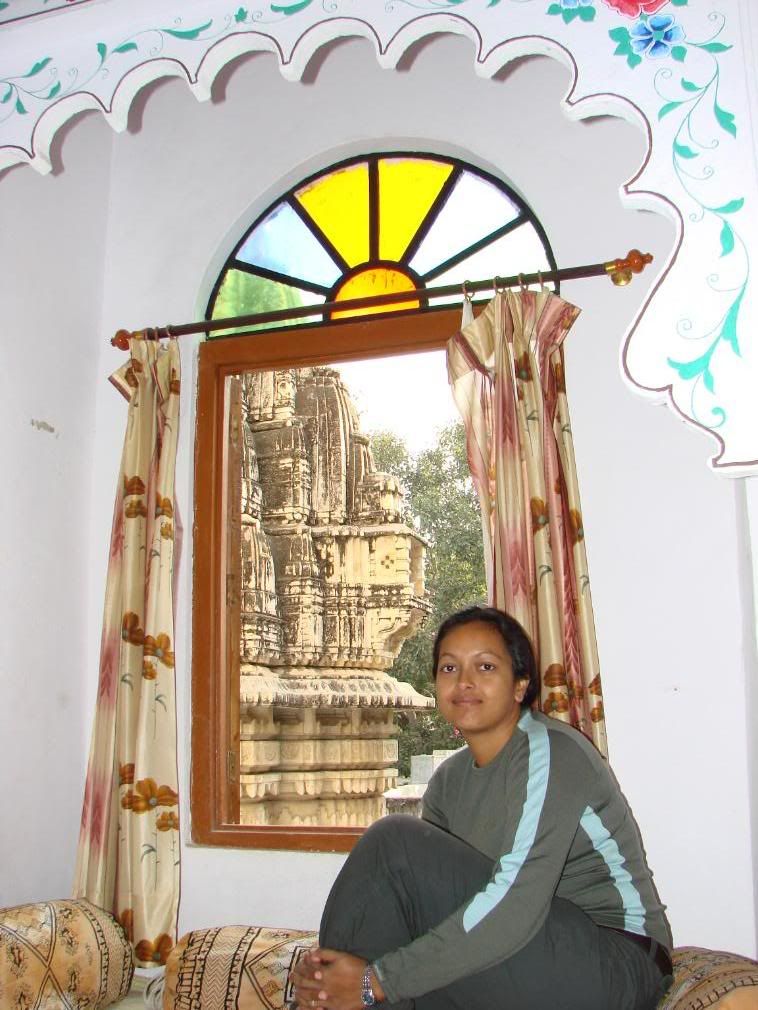
Following a long sleep-deprived night, we were dropped off at the side of some busy road in Mumbai where a string of autos were waiting to feast on the new arrivals. Another woman, also on her way to the airport, was getting hassled so Priti stepped in and started yelling at them in Hindi and demanded a much more reasonable price for the three of us. We had learned from Sapna that the only surefire way to get a response from many of the people is by yelling at them, and unfortunately we had to resort to this tactic on more than one occasion. At the airport, we were impressed how easy it was to purchase the tickets, in cash no less. Imagine trying to do that in the States. The one-hour flight to Udaipur on Kingfisher Airlines was nice. The auto into town was an interesting ride, as the streets were incredibly narrow and the driver had to stop several times and back up to let the oncoming vehicle squeeze by. We walked around for awhile and found a guesthouse with a nice view of the Lake Palace. Unfortunately, the hot water did not work and the bathroom window was broken, giving a full-on view to the adjacent hotel. When we complained, they put us into a much better room the following day. This room was beautiful with hand painted motifs on the walls, stained glass windows, and a window seat so close to one of the temples that we could nearly reach out and touch it, all for 300 rupees ($7.50).


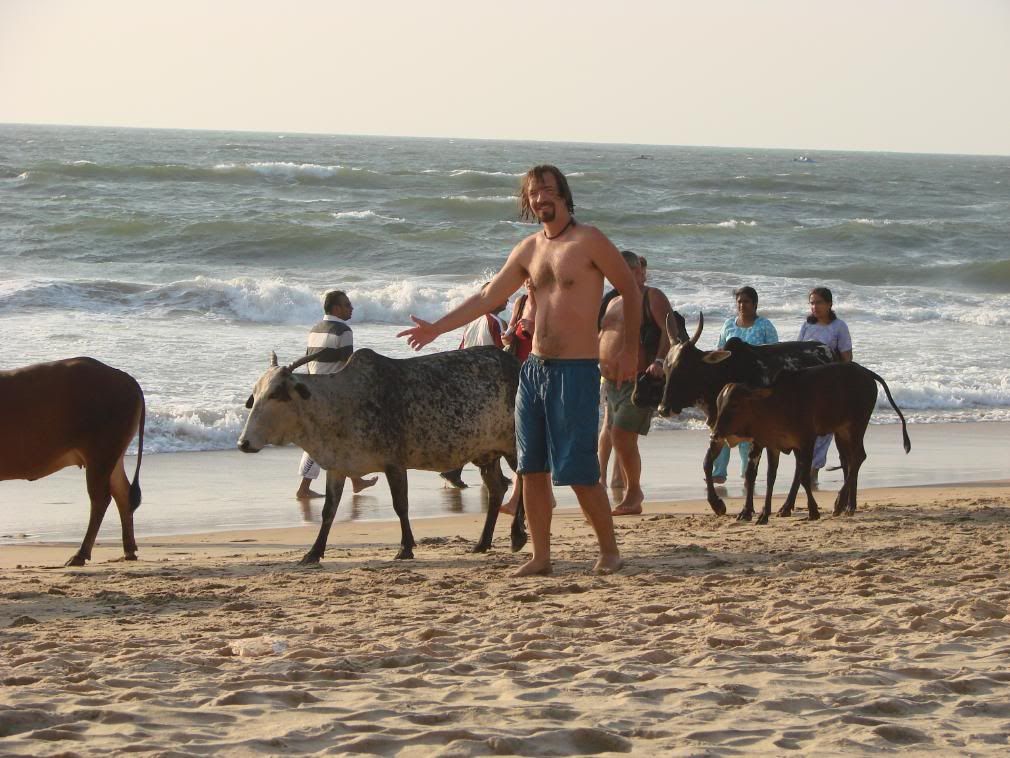
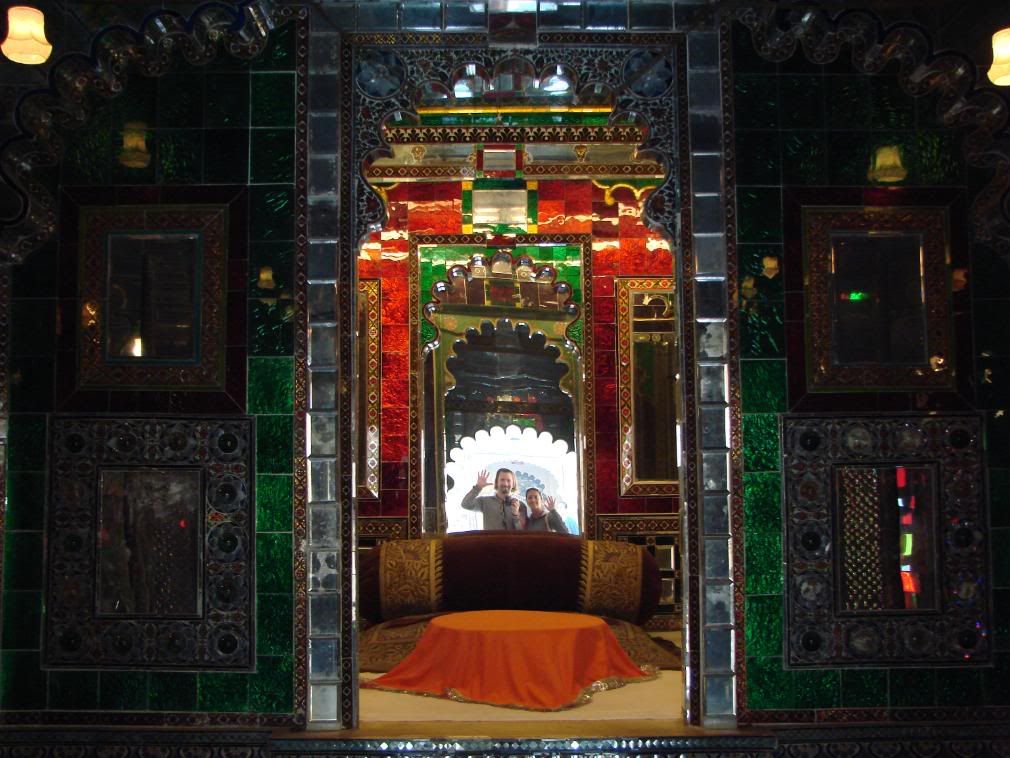
After enjoying thalis (4-5 different vegetarian dishes with rice and/or bread) for breakfast), we walked around the maze-like city of Udaipur, where winding roads veered off into alleyways about as wide as one car. Yet, despite the size of the roads, we still saw a few SUVs. There were many cows on the roads as well, and we saw them cause several traffic jams. We noticed people would stop and give them mythai (me-tie=sweets), and Jason was jealous when he saw on lucky cow chomping on a handful of ladoos. Our first sight was a nearby Hindu temple; inside were a group of mostly older women sitting on the floor, chanting bhajuns (worship songs) in front of a black avatar of Shiva. In the afternoon we visited the City Palace. As we neared the entrance, another tourist randomly handed us two tickets…score! Like the city itself, the palace felt like a maze. Each of the scores of rooms we visited was an interior decorator’s dream come true, adorned with antiques, hand-painted ceilings, and magnificent views.On our way back to our room, we listened to a local musician playing a Rajasthani stringed instrument at one of the lakeside ghats, which are platforms with steps leading down to the water. Jason put a down payment on a CD because he wanted to hear it first since it was just a copied disc. We agreed if we liked it we’d buy it but if not, we’d get our money back. As we ate an uninspiring dinner in the guesthouse restaurant, we tried listening to it but only a few of the tracks actually contained music. When we saw him again the following day, he had just made another sale to an older couple. When Jason explained the problem the musician became very defensive. The female tourist snidely remarked, “who cares, it’s only 300 rupies” to which Jason immediately offered to sell it to her for that price, which she of course declined. The musician wasn’t going to return our money until Priti started to raise her voice in Hindi, after which he held up his end of our agreement.


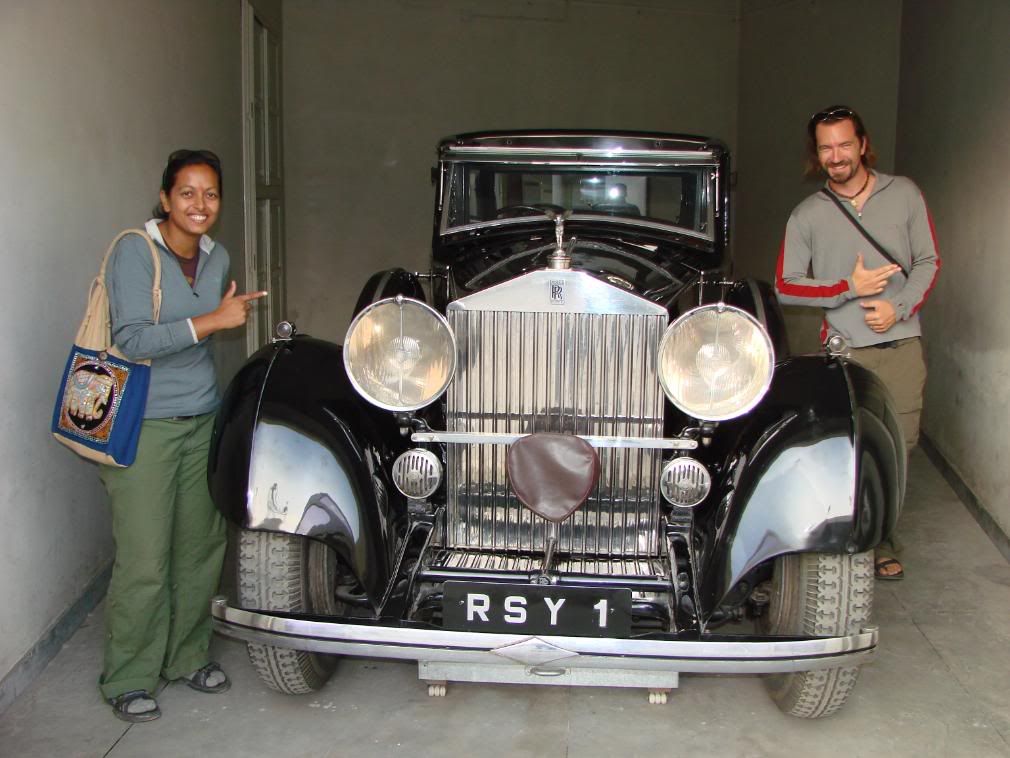
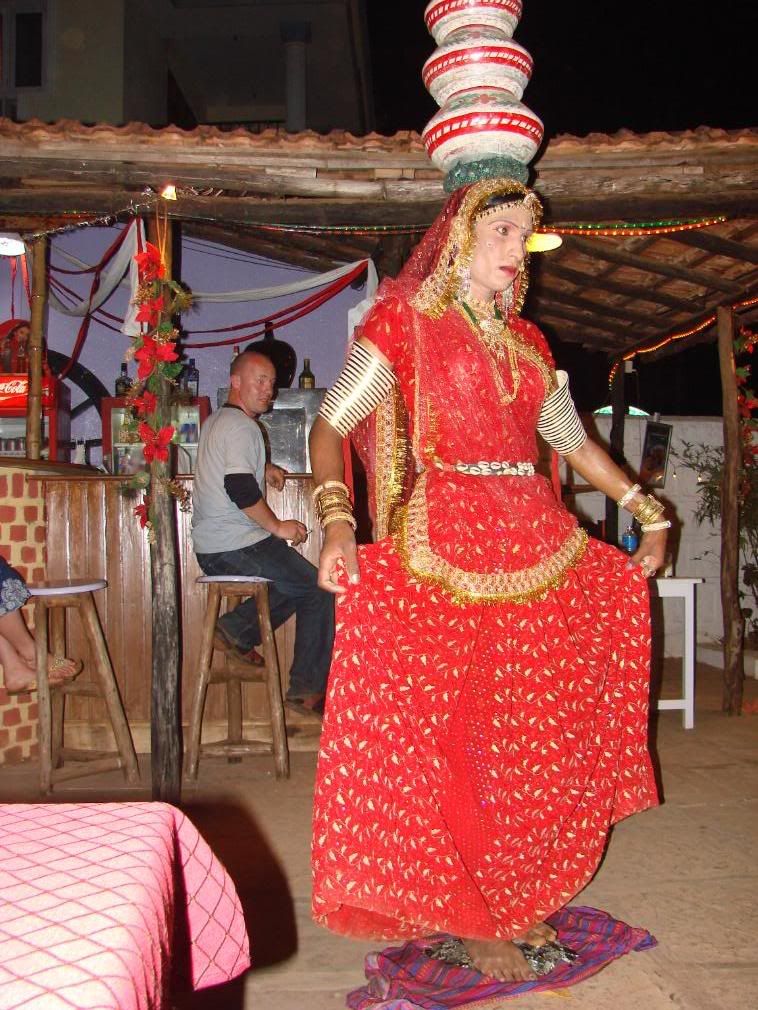
We meandered through the town, repeatedly losing our way while looking for the classic car collection of the local Raj (prince). The cars were pretty interesting, and one of them reminded Jason of the classic 1919 Rolls Royce his grandfather used to own. The collection also included the car James Bond drove in the movie Octopussy, which is screened every single night in most of the guesthouses in town. Somehow, we managed not to see it. The visit was also educational because we got to see some of the solar-powered vehicles that are growing in popularity in what is coming to be called the “green city.” For some reason, each of the cities in Rajasthan, like the so-called revolutions in the former Soviet Republics, has a designated color. At the conclusion of the tour, we enjoyed our complimentary soft drink; amusingly, the tickets read “Soft drinks with a touch of class.” That evening we attended a Rajasthani dance concert, and were again mesmerized by the feats of the dancers, including one woman balancing 10 bowls on her head while dancing on broken glass.

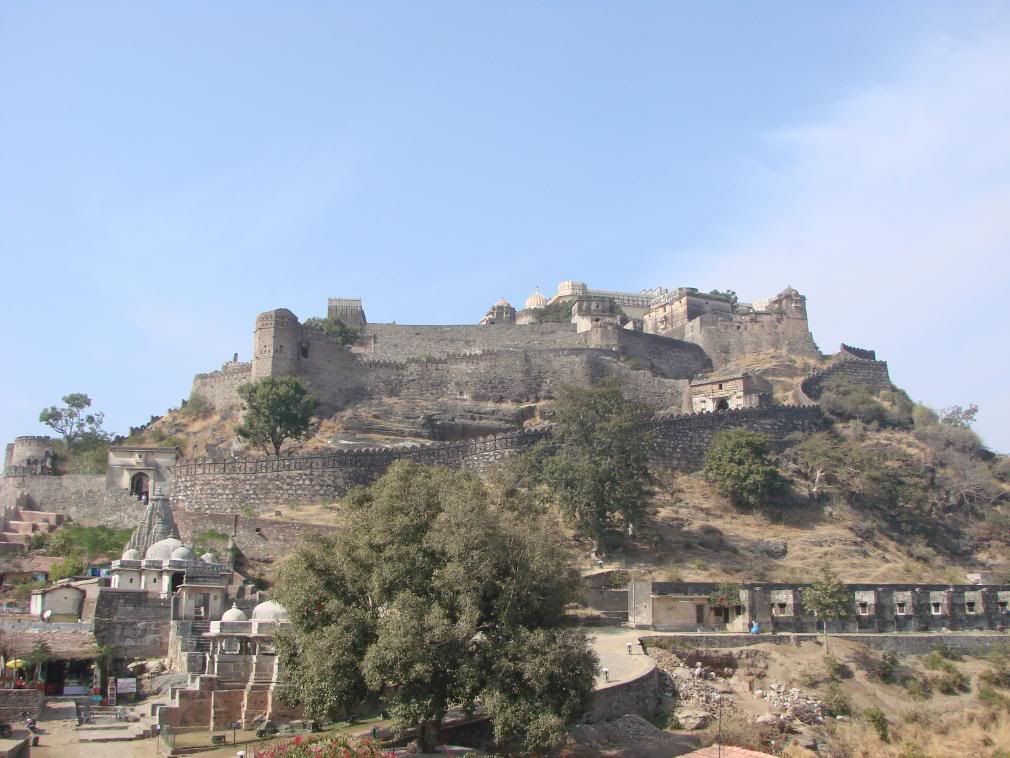
The next day we hired a driver to take us first to Fort Kumbhalgarh and then Ranakpurgh. During the long ride, we envied the future tourists who would take this day-tour after the road crews completed the paved road. Fort Kumbhalgarh is a massive now-abandoned fort that was once a key part of the Rajput empire. Just once had the fort been overtaken; three rivals joined forces for the siege but only managed to hold it for two days. As we wandered around, we understood how the fort was so secure while marveling at the vastness of the compound. There were scores of temples dotted on the landscape and we ventured off the main loop to visit one of them. When we circuitously arrived at a beautiful temple we had spotted from atop the fort, we were the only ones around, save for one boy who seemed to be some sort of security guard. Although the temple was locked, we enjoyed the solitude away from the hordes of school kids on field trips.


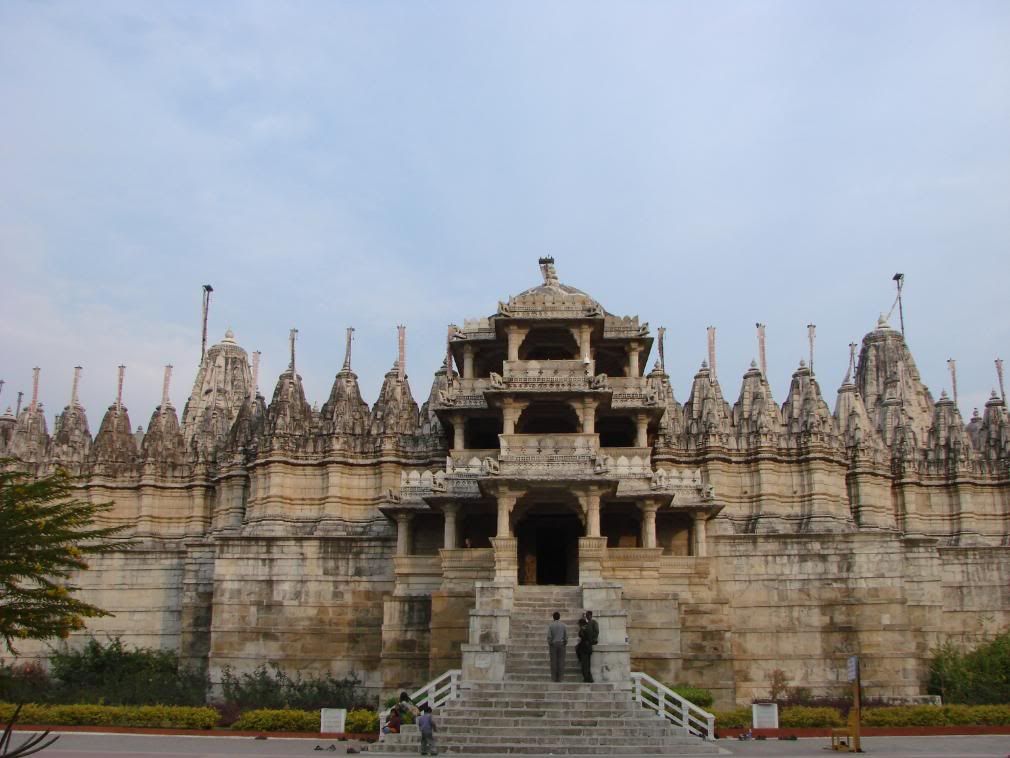
Then it was off to Ranakpurgh, home to a handful of Jain temples, including one of the largest in the world. Although the two places appeared to be very close on our map, the roads were incredibly windy and the journey took almost two hours. Jainism is an offshoot of Hinduism whose adherents are strictly vegetarian. The architecture of the temple was incredible, with thousands of stone columns, each one unique. We had to remove our shoes before entering (as in most temples in Asia). Supposedly no photos of their gods are allowed, although in other Jain temples we visited they were allowed, so we’re not sure. Also, it seemed a contradiction that a religion founded in opposition to religious dogma should be so concerned about taking pictures of their deities’ statues. The ride back was long and painful, and made worse as the driver appeared to be losing his sanity by the time we got back into the city.


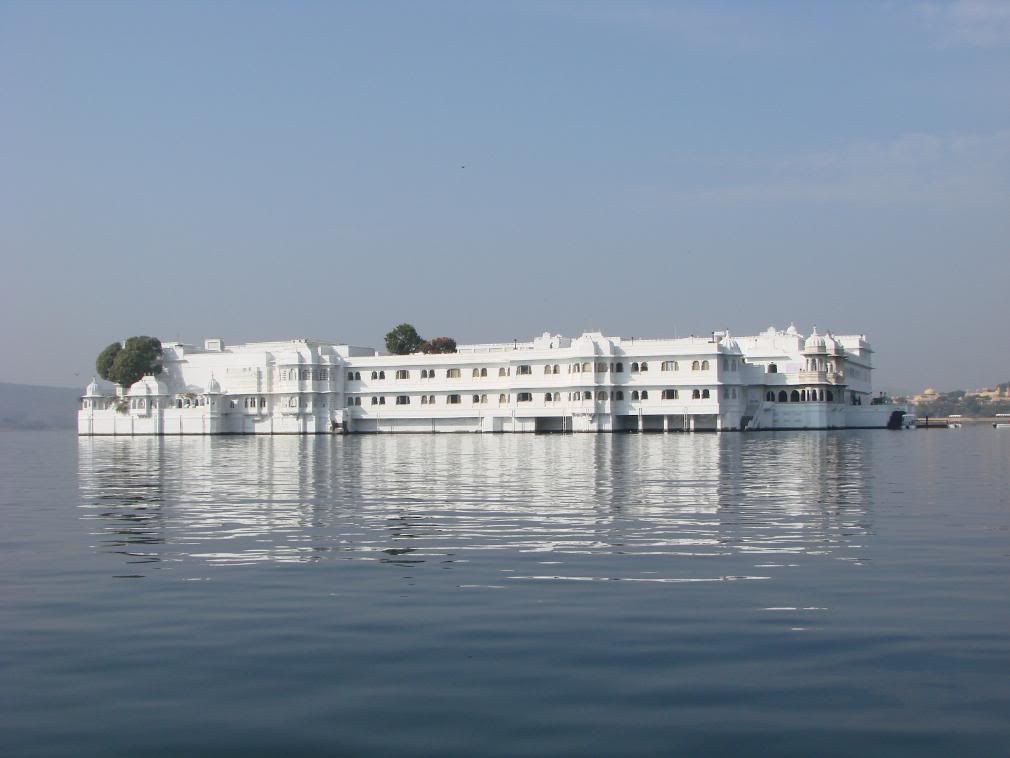
We saved what we figured was the best for last, the Lake Palace tour, which was the number one recommendation in the guidebook. The twenty minute boat ride in Lake Pichola provided some good photos but the palace itself was somewhat disappointing, likely because our expectations were too high. The gardens were mostly barren and we weren’t even allowed to visit one area the palace, so that our visit lasted around less than an hour, despite costing 325 rupees each. Nonetheless, the palace itself is like something out of a fairytale. And now, another small rant. It is common for other tourists to ask us to take their picture and we usually ask them to reciprocate. It has been our experience that many of these people show little to no concern for how the pictures turn out. For example, at the Lake Palace, Jason took a nicely framed photograph of this French couple, who reciprocated by taking an out-of-focus snapshot that completely cut off the view behind us. To all of the inconsiderate poseur photographers out there, Malf has only this to say: GET IT TOGETHER.


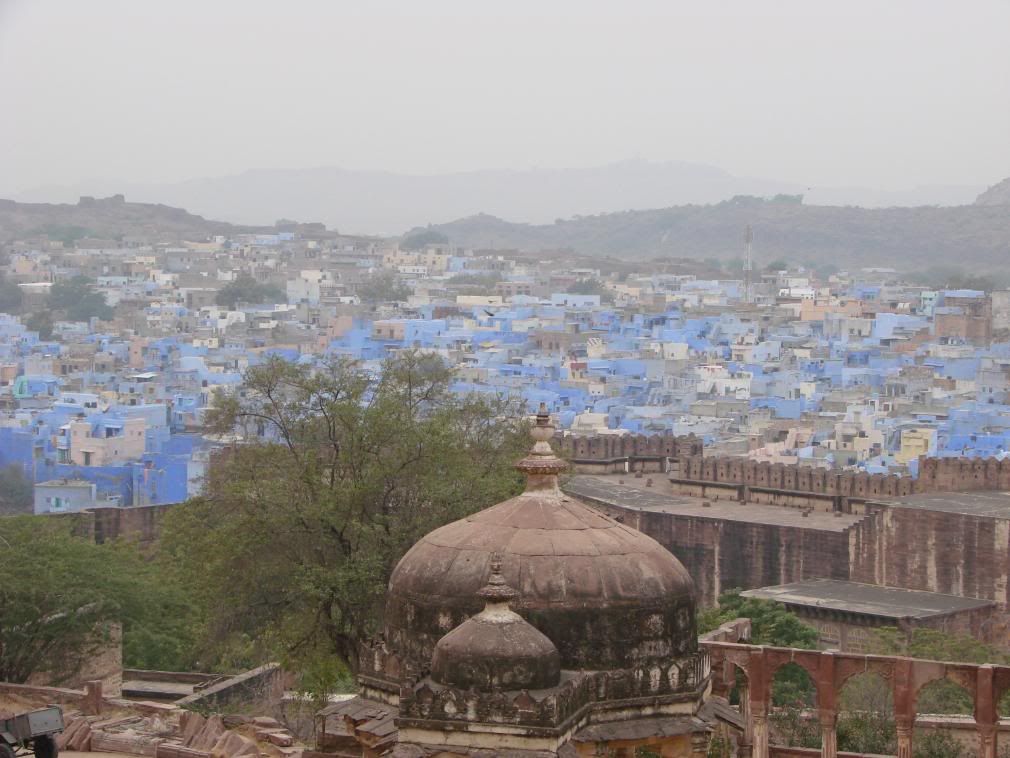
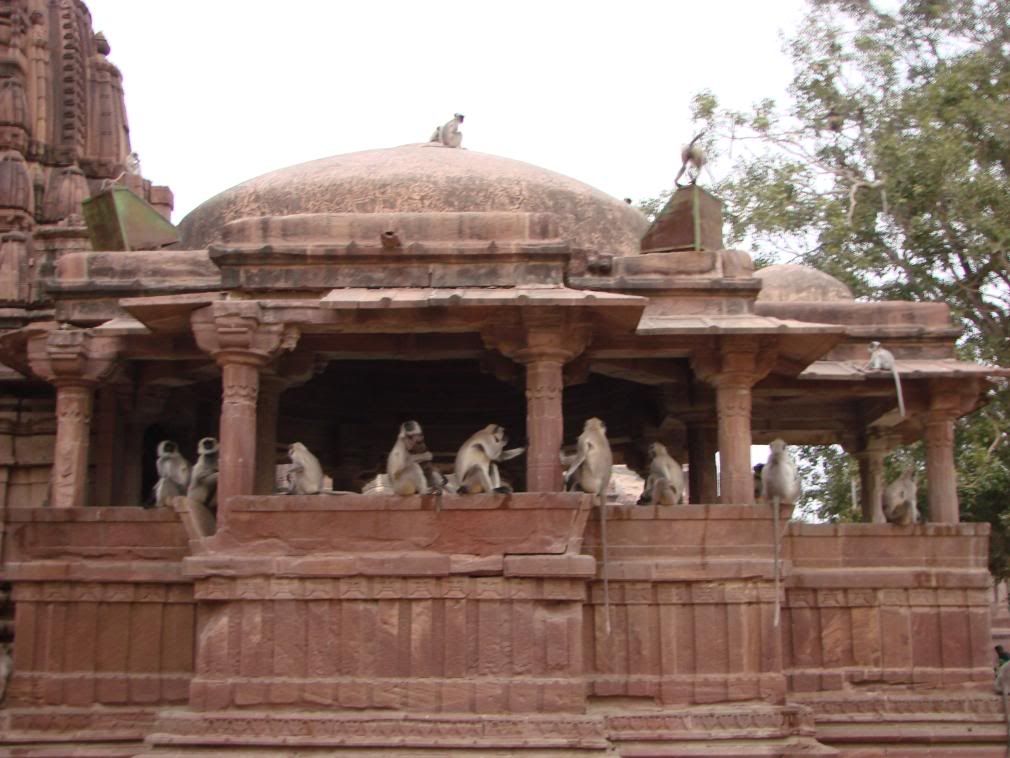
Later that day we caught the bus to Jodhpur, or the “blue city”, so-called due to its abundance of blue-painted houses. Once again, the bus was awful, and we suspected we were dumped on the local bus even though we had paid for a tourist bus. As we departed the bus, our noses were blasted with a mixture of exhaust and open sewage. By now we had gotten used to toxic smells, for India is covered with them, but Jodhpur was the smelliest place we had been thus far. On our way to the guesthouse, we looked aghast at the open sewers that flowed alongside the streets. Similar to Udaipur, our first room was unacceptable, but they moved us into a much nicer one the following morning. The next day, we tried looking for the tour bus recommended in the guidebook but when we got there, were told instead that we would need to hire a private driver at a ridiculous price. Instead, we stopped for lunch at Priya restaurant, and had exquisite bhel puri and Delhi chat, one of Jason’s favorite dishes. As with Mirabai, we ate most of our meals at this cheap and tasty establishment. Outside the restaurant, we negotiated with an auto driver to take us on the same tour for half the price. The first stop was the Bhavan palace, one of the last palaces built in India, but which was mostly a memorial to its builder. The next stop was the fort, which offered spectacular views of the city (which was actually blue) and had a great electronic audio tour. One gem was a story about this princess who was traveling in a covered-carriage, as royal women often did. (After spending six weeks in India, we both came to understand why this was practiced since a large majority of the men have staring problems) When a newspaper’s photographer captured a glimpse of her bare ankle and printed it, the family bought up every last copy of the newspaper to ensure that no one else saw. Another highlight was the weapons gallery, with daggers that had animal-shaped ivory handles and muskets with intricate gold inlays. Our last stop of the day was the Mandore Gardens, although the auto-driver tried to finagle his way out of taking us there since dusk was approaching. We ignored his admonition to “not take too long.” The park contained a series of well-preserved Hindu ruins, which were owned by these giant black-faced Macaque monkeys, the largest we’d ever seen. Half a dozen or so workers regularly fed them and we were almost intimidated as they outnumbered us humans about twenty to one. Atop one of the domed temples, a group of them were playing their version of king of the hill; one would sit atop while three or four others would run up and try to knock him off, incorporating flips and twirls like a pack of ninjas. It was mesmerizing. After awhile, we ventured off down this street but soon turned around as the stares we were getting from the men there did not seem friendly and some were outright menacing. Lastly, we visited the hall of heroes, which consisted of an entire galley of statues carved right into the rock. The statues consisted of deities from different religions followed by famous Rajput kings, some of whom held decapitated heads of their enemies.


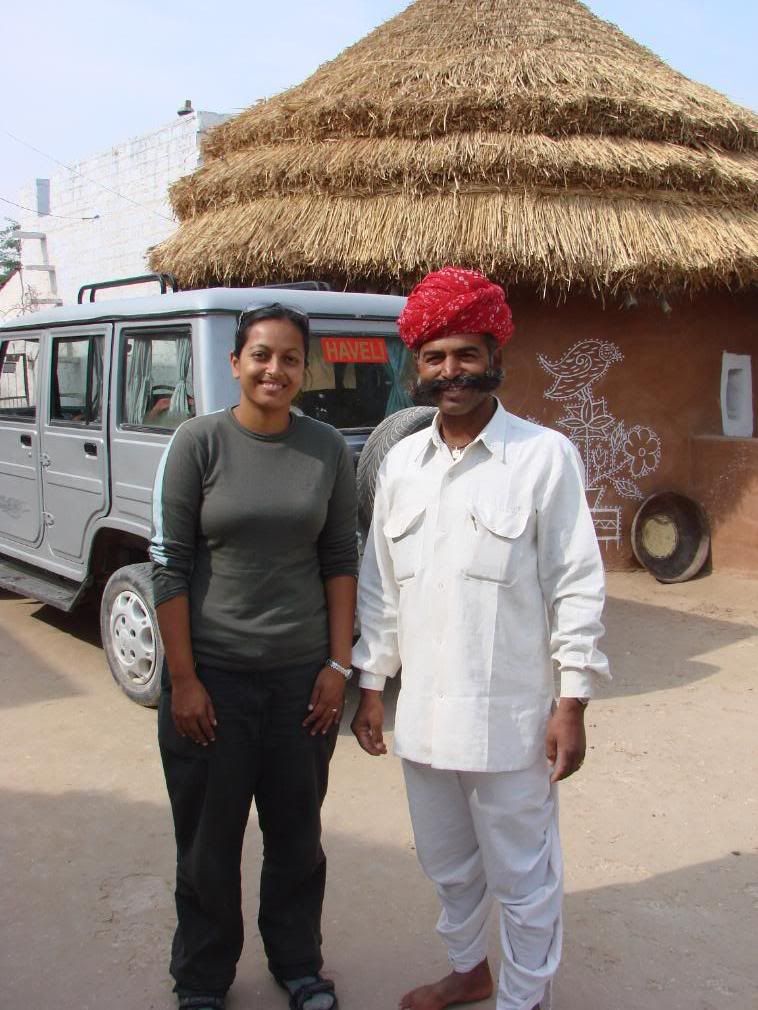
The following day we went on another day tour, this time to some of the outlying villages. Accompanying us was a gregarious Aussie family: JP, the father, reminded Jason of his uncle/godfather Danny; Kristin was studying criminology and shared some interesting insights about the difficulties of working with Aboriginal populations; and Oskar who was very bright and used words like presumptuous despite being only 13. At the first village, we took turns drinking very diluted opium water that is their customary welcome. We all looked in amusement as the local man finished the remaining half of the drink himself. After enjoying a great home-cooked meal at the next village we got to see how they make these incredible rugs, followed by encouragement to buy one, which we resisted. We couldn’t help but be amused at the men’s curly moustaches. The last village we got to see how they make earthenware pottery. We regretted not being able to purchase anything, but we knew we’d be back someday. That night, Jason purchased some sweets on the way back to our guesthouse. As he was eating a ladoo, a nearby cow caught a whiff of the food and gave us an imploring look to share our sweets. Although Jason looked at him and even said ‘no’ aloud, the cow started coming after us (or it). We hightailed it out of there and he eventually gave up the chase.


During our time in Jodhpur, we did purchase some nice textiles. The folks in our hotel offered to take us to their ‘brother’s’ place (in India, everyone is a ‘brother’) that was famous and supposedly frequented by many celebrities. The most recent was Madonna, who we had crossed paths with on our way to Jodhpur (she had departed for Udaipur the same day we arrived from there). We were led up three stories and couldn’t help but be impressed with the shear volume of textiles they had. While we sat waiting with a German couple for close to an hour while they closed another sale, we were shown a photo album of Bill Murray, Giorgio Armani, and Jason Schwartzman. After awhile, we just started looking through their stuff and became enamored with their exquisitely patterned Pashmina shawls. However, we suspected the price tag of 1500 rupees ($38) was inflated so we took off while the Germans got suckered. A vital piece of information to always keep in mind when traveling is that whenever someone brings you to a shop they get a HUGE commission, sometimes as high as 50% so it is never wise to purchase something until you arrive on your own. On our final night, after another delectable dinner at Priya, we found the exact same shawls for 900, meaning the other place had inflated their prices by 66%! The owner even explained how the whole ‘famous-patron’ shtick is a ruse. Jason was tempted to purchase one of their ivory-handled daggers (for who knows what but feared having it confiscated at one of the many airports we still had left to pass through. However, he couldn’t resist buying (or showing it off in the above picture) one of the ‘retro-pimp’ shirts that he had seen so many of the locals wearing. The store had supposedly fixed prices and the shirt’s tag read 550 but when Jason was able to bargain in Hindi, the shop-owner gave in to ‘theen sow’ (300). As we packed our nearly overstuffed bags that night, we realized the discipline we had maintained throughout our trip to minimize our purchases was rapidly dissipating as we neared meeting up with Priti’s mother.


When we had booked our overnight train to Jaisalmer, we were not sure what class to book because the woman behind the counter could not explain the difference and the guidebook was confusing. For those traveling to India, there are basically three options: 1) Sleeper—cheapest option with eight berths per car (three by three with two more opposite the aisle), no bed sheets, and no climate control; 2) 2AC—most expensive with only six berths per car (only two by two), with bed sheets and climate control; and 3) 3AC—hybrid of the two with eight berths, bed sheets and climate control. For any overnight journeys we highly recommend splurging on the 2AC or 3AC. Since it was just six hours and we didn’t know any better, we went with the cheapest option, sleeper class. One of the windows didn’t close, so the compartment was freezing cold and our sleeping bag liners didn’t help much. We were in the middle berths on each side, and the scumbag sleeping in the berth below Jason (meaning Jason couldn’t see him) stared at Priti all night, and even tried rubbing up against her several times as he walked by.


Thus, our arrival in Jaisalmer at six AM was a tired one, and we were immediately greeted with a group of obnoxious touts trying to get us into their hotels. We had read that the fort inside ‘Gold City’ was sinking and thus it was not environmentally responsible to stay inside it, so we went with a place outside of the fort. Continuing the Rajasthan pattern, the first room they gave us was awful and the toilet didn’t even work. This time we didn’t wait to demand another room and after Priti started yelling and we made for the exit, they gave us their best room for the same price we’d agreed to for the first sub-par room. Despite the early hour, they tried getting us to commit to booking a camel safari with them but we stalled, knowing we’d find it cheaper elsewhere. After catching up on sleep, we wandered into the fort and met some really nice guys, who invited Jason to play Karam, a board game akin to billiards with chips. After six straight losses, he bowed out. As we wandered around the labyrinthine Jaisalmer fort, we came across a jeweler shop that is renowned for its intricate engravings and many couples have their wedding bands made there with rows of symbols that represent their lives together. Although we didn’t buy any, we had fun coming up with our own list of symbols, like the St. Louis Arch, a saguaro cactus, Ganesh, and the earth, to name a few.


The next day we took a camel safari out into the desert. Despite our misgivings about being on camels for about eight hours over two days, we thoroughly enjoyed it and this was one of the highlights of our trip thus far. We both developed a tremendous amount of respect for camels, which require very little food and water yet are so useful for long-distance transport in the desert. Plus, they are easygoing and not skittish like some horses. We were glad our guides had not tied the camels together like another group we had seen, and they even let Jason’s camel, Kingfisher, ride ahead of the pack, allowing him a true Lawrence of Arabia feeling. The only drawbacks to Kingfisher were that he was not very friendly (wouldn’t let us pet him) and had the most horrible breath ever, which he kept belching up because he was constantly chewing shrubs. Interestingly camels move their jaws horizontally, rather than vertically, when they chew. Priti’s camel was much friendlier and even reached its head around to scratch its nose on her leg. Although riding became a bit uncomfortable by the end of the day, our legs were not too sore. The uninterrupted dunes stretched off into the horizon and were amazing to behold. After we stopped for the night, Jason had fun launching himself off the dunes into the soft silky sand. Our campsite was very close to the Pakistan border, and the guides themselves appeared more Pakistani or even Afghani in appearance, with dark skin and very light eyes. It was interesting to see them drinking water out of the same trough as their camels, which we surmised they’d been doing their entire lives. They were very friendly and cooked us a wonderful meal and sang Hindi film songs around the campfire. There were no tents, and Jason fell asleep by counting the shooting stars (he got to twenty).


Upon our return from the camel safari, we discovered that all of the hotel owners would not give us a reasonable rate because they knew we had just returned from a camel safari, which is the real money-maker. So we returned to the travel agent that had booked us the safari and took a room inside the fort. Considering that most of the shops and many restaurants are located within the fort, we didn’t think our one night could be that environmentally harmful (don’t tell Al Gore). That night we went to the Dylan Café, so named in honor of Bob Dylan. There we hung out with Om, who possessed a wealth of music and put all of our photos and videos on a DVD since we had been unable to find a good internet connection. The next morning, we awoke to discover that there was no water in our room (even though we had been told there was hot water). And because for some unknown reason, all the places have a 9 am checkout, we did not have time to shower for the third straight day. We both agreed we wouldn’t pay the full price since there was no water. When we informed the worker, he made a fuss and then promptly got his manager. As Priti argued with the manager in Hindi, he furtively directed the worker to go turn on the water, and afterwards went up to the room to show us that it did work and we were lying. This set Priti off and although we planned to give 150 instead of 200 rupees, his antics meant he wasn’t getting more than 100. He scoffed and said he wouldn’t accept that, so we just left without paying anything. But now we were stuck with our bags…oops. It took us an hour to find the Dylan Café; whenever we asked the locals its whereabouts and spelled it, they called it ‘dialin’, much to our bemusement.


That evening, as we boarded the long, long, long train to Delhi, we were sad to be leaving Rajasthan because it is an amazing place but we vowed to return, especially since we didn’t get to see some of the other highlights like Jaipur, the ‘pink city’. There is a reason this is the Indian state that receives the most tourists each year and in our opinion no visit to the sub-continent would be complete without seeing it. At the same time, we were very excited to see Priti’s mother in Delhi, as well as the rest of her family in Bihar, all of which will be detailed in the next blog entry.

Wednesday, March 5, 2008

Bombay & Goa

Bombay/Mumbai

Our arrival in India was filled with great anticipation as Jason had never been there before and Priti had not been since her sister Julie and Kiran's wedding in 1999. We allotted more time here than any other country, seven weeks, which is really not very long because India is massive, hence its nickname as the sub-continent. Stepping out of the airport at around midnight, we saw a sea of brown faces awaiting their friends and families; thankfully our host Rajesh and his father were waiting for us with our names on a sign and it was pretty easy to spot Jason amongst the crowd (and contradicting our speculation in the Philippines entry that we’d never again be greeted at an airport with a personalized sign). Although we had never met them, and our connection distant (family friends’ in-laws) they treated us throughout our stay as if we were immediate family, and referred to Jason as ‘dhamadh’ or son-in-law. We arrived at their place in New Mumbai and were immediately offered a wonderful home-cooked Indian meal; the best cure in the world for a minor bout of homesickness. As we continued eating, not wanting to leave food on our plates for fear of offending our hosts, more and more food kept getting piled on. By the end of the meal we were both stuffed. Somehow we were uninformed that in India an empty plate signals that the person is not yet satiated so more food will be offered until there is food left on the plate…vital information for anyone traveling there and staying with hosts.

The following morning, after another wonderful meal (a phrase you will read often), we learned that there was a water shortage and thus they had to fill up buckets whenever the water was turned on. It was Jason’s first time taking a bucket shower and we both came to realize how much water is wasted using western showers, although we still prefer them. Freshened up, we went to the train station where we met Raj’s friend Ashok and his family, who were new arrivals to the city and thus accompanied us to the sights. Since we were not in a tourist area, Jason was the only non-Indian, and received lots of stares from the locals. Once in the train station, we got to witness the daily chaos that defines Indian rail travel. As the train approached, we could see passengers hanging out of the doors of each car and before the train even stopped dozens of them jumped off running in order to stop their momentum. As the throngs around us surged forward, it quickly became obvious that all six of us were not going to get aboard, so we held back and waited for the next one. Our strategy changed and Priti and Ashok’s wife went to an area to board a women's-only car so they wouldn't have to be subjected to the inevitable groping that happens in the dual-sex cars. As we once again pushed forward toward the door, we managed to squeeze in to the large sardine can with wheels; although we had ridden packed trains before (like in the Philippines), none of them compared to this one. From the station we took autos (same as tuk-tuks in Thailand) to the Gateway of India, which is a large fort dedicated to some British bloke and also the launching point to Elephanta Island. Behind it was the famous Taj Hotel. It was very hot and we had to wait quite some time for the ferry. The ferry itself took another hour and by the time we arrived at our destination we were both pretty exhausted. Also, having just seen Angkor Wat, the highlight of the island, a massive three-headed statue of Shiva, the Hindu god of creation and destruction, was not as fascinating to us as the rest of visitors. There were also temples built into caves. Inside some of them were lingas, which are phallic symbols of Shiva that represent fertility and adorned with coins, which would attempt to stick on; if the coins stuck it meant a baby would be forthcoming. We abstained since we want to wait until our trip is over before having our own. Speaking of, whenever we told Indians that we had been married for four years, their immediate follow-up question was "and how many children?" They never failed to look disappointed, and often sympathetic, when we replied "none yet."

However, at least then we weren’t stuck with the rest of them trying to get somewhere as we were from the moment we got in the car at 9:30 am until the moment we got out at 9:30 pm. Twelve hours in 90 F with humidity in a non-air-conditioned car is enough to drive anyone insane; we have no idea how the drivers do it day in and day out. Having lived in Arizona for four years, we thought we had acclimated to the heat, but the humidity in Bombay is suffocating, and set a record low temperature of eight degrees Celsius (~ 45 degrees F) a month after we left! The first stop (about three and a half hours after we left) was the ‘aquarium.’ Hailing from Omaha and Chicago, home to two of the best aquariums in the world, we had a hard time calling it that ourselves. It consisted of one medium-sized room, with rows of tanks, all of which were too populated, too small, or in most cases, both, for the marine life inside. Nonetheless, it wasThe next day we woke up early for a day tour of the city with Ashok and his wife and one-year-old daughter since Raj had to work. In short, Mumbai is HUGE. There are about 25 million people and throughout the three days we never found ourselves not surrounded by them. Geographically, the city never seems to end, as we had discovered the day before on the ferry. packed, and we were whisked along by the other visitors and were finished after about 20 minutes. Then it was back into the incinerator for another hour until we reached the Hanging Gardens. They were a much-needed respite from the city congestion, but we were disappointed that the famous view of Chowpatty beach was virtually non-existent due to the intense smog, which was much worse than anywhere else we’ve been. While strolling through the gardens, a group of young Indian men stopped Jason to have their photos taken, the first of many such instances. He tried unsuccessfully to keep it from going to his head. From there, we visited one of the Bollywood set locations. It is normally off-limits but since Jason was sitting in the front seat the guards assumed he was someone in the biz and didn’t stop us. We drove around and saw some of the sets and then turned around because the driver didn’t know where else to go. As we left, Jason had the tour book out and so the guards stopped us and questioned our whereabouts before letting us proceed. Our next stop was this pond that draws unsuspecting visitors to paddle around its confines. During our 30 minutes of paddling, we figured out that the reason pictures and video is strictly forbidden is because if word got out how pathetic it was, no one would ever visit. After the ride, we stopped for some snacks and had some massala-flavored snacks that had the texture of crunchy cheetos. Finally, we visited the Hari Krishna temple, which had scenes from the Bhagavad Gita represented with life-size models as well as a live re-enactment of one of the scenes. Although not religious, Jason found some of the passages accompanying the models to be very aligned with his mystical views on the nature of reality. We bought some tasty ladoos to cap off our long day. Throughout our entire stay, our hosts refused to let us pay for anything and did everything they could to make sure we were enjoying our stay. Too bad they couldn’t control the weather or the traffic. Raj and Jason spent the remainder of the night sharing music and Raj even loaded six CDs of traditional Indian music onto our jump drive.

Our final day in Mumbai/Bombay (like Ho Chi Minh City, it seemed whenever we said one the person said the other) was much more relaxed. Since Raj was working, his father took us out for massala dosa, which is a crepe filled with vegetables and one of our favorites. The dosas were massive and filling, yet we had to convince Uncle not to order more food. Afterwards, we went to see the latest Bollywood blockbuster, Welcome, a comedy where the hero falls in love with a woman from a mafia family. India actually produces more films every year than Hollywood and the locals we’ve met in just about every single country on our trip are big fans. Amitabh Bachan, with his snow white goatee, his replacement Shah Rukh Khan, and the former miss universe Aishwarya Rai, who married Bachan’s son, are household names throughout Asia and were ubiquitous, their faces plastered on just about every billboard. Front-page news stories during our stay included the release of Khan’s income tax returns (he earned five times the next highest paid actor) and a school being named after Mrs. Rai (although her husband was inexplicably absent). Incredibly, none of them were in the movie, although the stunning Mallika Sherawat (far right on poster) played a supporting role. There were no sub-titles so Priti had to translate, though there were many English words sprinkled in, as English and Hindi are both official languages (Hinglish?). The movie was funny at times and the soundtrack was good. The house was packed and we suspected that the Nepalese guy sitting next to Jason was high on something; he went to the concession three times during the movie and each time brought back something for Jason, all of which he politely refused. After the movie we browsed some of the shops and then got our bus tickets to Goa, as the much-preferred trains had long been booked for the upcoming New Year’s celebration. We took photos with our hosts and noticed something odd—no Indians smile in their pictures. Jason decided from then on to stop smiling in pictures while in India, much to the annoyance of Priti.

Goa

We were a bit nervous heading to Goa during the most popular week because with the booming Indian economy, many more Indians are traveling and thousands flock to the beach-infused state for the final week of the year. The sleeper bus to Panjim (the capital) was not too bad but we initially thought our fears had materialized, as the first four guesthouses that we stopped at (all from the guidebook) were completely booked. Mercifully, travel life exists outside the confines of Lonely Planet, and we managed to find reasonably priced accommodation (albeit still double the normal rate). Jason courageously or foolishly decided to rent a scooter so that we could visit Old Goa. Despite a couple close calls, he managed to get us there intact. Because Goa was first colonized by the Portuguese, it has the highest proportion of Christians in the country and we actually managed to make it to church on Christmas Day.
We visited several of them in fact, one of which houses the remains of St. Francies Xavier. It was surreal for him to see groups of Indians kneeling in prayer before a large crucifixion sculpture while listening to Christmas jingles in the background. Since Panjim was not on the beach, we decided to head north to check out some of the different beach towns because there are about a dozen to choose from. First we checked out Anjuna, which is popular with westerners for its supposed ‘hippy’ vibe. After our previous experiences in Pai, we were skeptical and after seeing hordes of yapping yippies with Bob Marley blaring in the background, we crossed it off our list.

After checking out a few other spots, we took the public bus to Calangute. We stopped at a few places to stay but they were either booked up, outrageous or total dumps. Once again, the fears were creeping in, so we headed for the beach and just started walking along it, hoping somewhere would fall into our laps. Thus, for the first time in five months, we had to convert our larger bags to backpacks. So for those of you considering taking an extended trip, we highly recommend getting bags with wheels. We walked for about fifteen minutes before someone brought us to a guesthouse just a few hundred meters off the beach. It was still overpriced by Indian standards for essentially a beach hut ($20) but we didn’t want to press our luck. We quickly changed and headed back to the beach, which is one of the longest uninterrupted beaches in the world, and stretched as far as the eye could see in both directions. It was packed with mostly Indian men, many of whom walked hand in hand and way too many donning only tighty whities. Others had cameras and were furtively taking pictures of the women in bikinis. All along the beach are shacks that offer food and drink and padded beach chairs with umbrellas. Jason went out to ride the waves of the Arabian Sea, which would turn over all the way to the beach. Several times they were so strong that the flipped him over and he ended up more than once with his head planted in the sand. Because of the violent surf, the lifeguards were vigilant and would not let swimmers go out further than about 30 feet. Many of the Indians in the water did not appear too comfortable and Jason almost had to rescue one Sikh man who had strayed too far out. About a dozen passers-by stopped to have their photos taken with Jason, who had by now-in his-mind-attained full-on rock-star status.

Meanwhile, Priti mostly stayed in the shade, engrossed in Zorro, an excellent novel by Isabel Allende. One of the best things about traveling (or more precisely, not working) is that there is so much free time to read books. We have read many great and some not-so-great books during our trip, and at the end will post a complete list along with brief reviews (in honor of Sapna, who told us in Bangkok that she had been rating all books she had read to post on their blog but in a spate of self-consciousness had shredded them). At nights, many of the beach shacks would turn into dance clubs that blasted trance and bhangra music until dawn. And so our days at the nearest beach shack and nights in the clubs passed by in Goa. After frantically zipping around SE Asia and then Mumbai, we were content to just kick back on the beach and enjoy the nightlife. Actually, another recommendation for those considering extended travel is to plan interludes of ‘vacations-within-the-vacation’ where you just veg out, because although traveling can’t really be described as difficult, it is easy to get worn out by trying to see and do everything in every place on one's itinerary.

Some of the daytime highlights included the daily procession of cows that straggled onto the beach before being chased away by the dogs. One chilled out cow spent most of one day lounging next to us. A British family that spent every day in the same shack had two teenage daughters who were constantly being stared at, even though one wasn’t older than 13. Several times, they started shouting obscenities at Indian perverts who were taking video. On the one hand, we sided with them because the Indian men could be completely obnoxious perverts. For example, while we were walking down the beach at night, obviously together, a group of men passed by and one of them reached out and groped Priti’s rear end. She yelled at him and Jason started to go after him, but he ran off just as would be expected from desperate loser. At the same time the older daughter was wearing a very skimpy bikini in a modest country, so could it really come as a surprise when she got stares? One unattractive older woman even had the audacity to sunbathe topless! Another highlight were the sand castles they constructed which were huge and looked like some of the temples we would soon see. We returned to Anjuna for the famous Wednesday market that was ridiculously huge, with merchants descending from regions far and wide to sell their goods. Jason couldn’t resist and purchased a few shirts and a necklace.

Nighttime highlights included the restaurant right next to our guesthouse, Mirabai. They had live music several nights a week, but the food was outstanding. Their tandoori chicken ($4 for a whole chicken) was the best we’ve ever had and the took over an hour to prepare on the grill; by the time we left, we were eating there exclusively. We also sampled the Kingfisher beer which was decent enough. One night we watched a Rajasthani music/dance group which featured a cross-dresser who, among other amazing feats, balanced pots on his head while dancing on broken glas. At most of the clubs, 95% of the dancers were men, and we couldn’t help but laugh when some of them would get up on the platforms and twirl their shirts around, a scene we would expect to see at a gay club. We reluctantly spent New Year’s Eve at a nearby shack/club that provided a full dinner and unlimited drinks for just $20 per couple. As expected, the food was sub-par but at least they didn’t run out of booze and had good music and entertainment, including fire dancers that mesmerized the guests and onlookers alike. Speaking of entertainment, Jason proved to be one of the biggest draws of the evening, for every time he went out to dance he was literally mobbed by dozens of Indian men who wanted to dance with him. Furthermore, when he was dancing, big crowds would gather at the barrier to watch him, and then some even paid the entry fee just to join in the frenzied dancing. Thus, the owner of the place was thrilled and even offered us to his house for dinner the following night. During the insanity, Jason began to understand the dual-sided nature of celebrity; the fans may appear to adore the celebrity but really they just relish what the celebrity represents. In his case, it was a white man who could dance like an Indian. While the throngs fawned over Jason, Priti was being looked after by a very nice, albeit naïve, Sikh man, who warned her about her Bacardi Breezer "benji (sister), that’s not juice, you know that has alcohol in it?" Meanwhile, his friend started putting the moves on her, and eventually Jason had to enlist his handlers to take of him (hah, actually, he took care of it himself). When we returned to the room, Jason capped off his rock-star fantasy by serenading Priti with long songs from his MP3 player, much to her chagrin and anyone else within listening range.

We spent our last day in Goa as we had the rest, lounging on the beach. We booked a bus ticket back to Mumbai, which had increased a ridiculous fifty percent because of the date. We looked into flights directly to Udaipur, our next stop, but they were prohibitively expensive, so we booked a much-cheaper flight from Mumbai because we couldn’t stomach back-to-back 10 hour bus rides. The shuttle bus that was supposed to take us back to Panjim from Calangute was full so we had to wait an hour for it to make the roundtrip return. There were some children begging and one of them reacted to receiving our bananas as if we’d just made her day; it broke his heart when she came over and clutched Jason’s hand as our shuttle departed. When we got to the bus station, we got shuffled onto our bus and realized that is wasn’t the same company we’d taken to Goa; the sleeping compartments were smaller, and the driver was much less considerate of his sleeping passengers…so concludes part one of our India adventure.